
We earn a commission if you buy through these links. Learn more
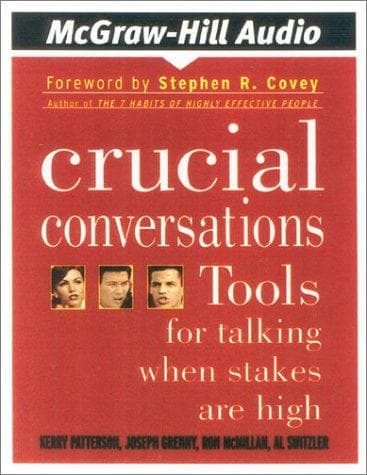
Crucial Conversations
by Kerry Patterson, Joseph Grenny
A concrete method for steering tense, high-stakes conversations toward honest dialogue instead of silence or blowups, with scripts you can actually use.
What It's About
Crucial Conversations is a nonfiction self-help and communication guide, not a novel, so the Fiction label in your listing is a mistake. Kerry Patterson and Joseph Grenny wrote it with Ron McMillan and Al Switzer. It is built around a problem most of us handle badly: the talk where the stakes are high, opinions clash, and emotions run hot. The authors draw on their consulting work and on observations of people who handle hard talks well.
The approach is practical and skill-based. The book offers a working framework with memorable phrasing, illustrated through many short case studies from workplaces and personal lives. Its central tools include noticing when a conversation has turned crucial, restoring a sense of safety when people start to clam up or lash out, separating observable facts from the stories we tell ourselves, and phrasing your views so others can hear them and respond.
Reading it feels like sitting in a workshop. You will come away with a mental checklist and a few sentences to try the next time a difficult talk looms. It suits managers, partners, parents, and anyone who dreads confrontation. It is less useful if you want deep theory about why conflict happens or a detailed account of the psychology behind it.
Read this if you…
- Dread a specific upcoming conversation with a boss, partner, or family member and want a plan for it.
- Manage people or teams and need shared language for giving hard feedback.
- Prefer practical, scriptable techniques over long theoretical discussion.
Skip it if you…
- Want a deep account of why conflict arises or the psychology behind it.
- Find self-help frameworks, acronyms, and bullet-point models tiresome.
Key Ideas
- 1
Start with what you really want
The book argues that the first step in a hard talk is clarifying the outcome you care about, both for yourself and for the relationship. Many people walk in aiming to win the argument or to vent frustration, and those goals quietly shape everything that follows. Asking what you truly want keeps you from sliding into tactics that damage the connection you need.
- 2
Keep the conversation safe for everyone
When people feel threatened, they tend to go silent or turn aggressive, and either response shuts down honest exchange. The authors describe how to spot these warning signs and how to rebuild mutual purpose and mutual respect before pushing on the substance. The idea is that safety is a condition you build during the talk, not a mood you hope for.
- 3
Notice the story behind the emotion
Strong feelings usually rest on conclusions about someone's motives, which the book calls stories. The advice is to separate what you directly observed from the meaning you have attached to it, then test that meaning out loud. This habit changes a frustrating accusation into a question you and the other person can actually examine together.
- 4
Share your views and invite theirs
A core technique is a short sequence of steps for stating your view clearly while genuinely inviting the other person's perspective. You share your facts, explain your reasoning, ask for theirs, speak tentatively rather than as a verdict, and encourage them to challenge you. The book's point is that open invitation, more than eloquence, is what keeps people engaged.
Limitations
Critics say the book leans heavily on anecdotes and tidy formulas, and that real conversations rarely follow a neat sequence. Its examples come mostly from workplace and personal scenarios viewed through the authors' professional lens. It says relatively little about power imbalances, such as speaking up to someone who controls your job or safety, where the problem is not only a matter of skill. The second edition in 2011 refreshed the examples, but the core model remains largely the same.
Questions Readers Ask
- Is Crucial Conversations still worth reading?
- Yes, for most readers. Its core ideas about keeping dialogue safe, separating facts from stories, and inviting others' views are not tied to a particular era. Some examples feel dated, and the book's tone is very much of its time, but the practical advice still applies to meetings, family talks, and most high-pressure exchanges.
- How does it compare to Nonviolent Communication?
- Nonviolent Communication by Marshall Rosenberg emphasizes empathy and needs-based language, with a more relational and reflective feel. Crucial Conversations is more tactical and workplace-oriented, offering step-by-step techniques for specific high-pressure moments. If you want a philosophy of compassion, choose Rosenberg. If you want tools for an upcoming difficult talk, choose this.
- Is this book fiction?
- No. Crucial Conversations is nonfiction, though some listings mistakenly place it in fiction. It is a practical guide to communication, illustrated with case studies rather than a story with characters and a plot.
- Published
- 2001
- ISBN
- 9780972446228
- Difficulty
- beginner
- Category
- Fiction
Book details and cover from Google Books.
Ready to read Crucial Conversations?
Get your copy on Amazon, or listen to it on Audible. We earn a commission if you buy through these links.