
We earn a commission if you buy through these links. Learn more
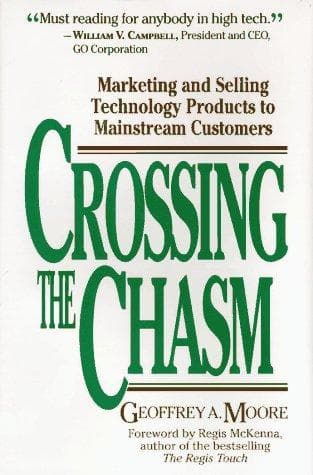
Crossing the Chasm
Guide by the Books of the Day editors · Updated · How we write our guides
Geoffrey Moore's short, practical guide explains why promising technology products often stall between early enthusiasts and the mainstream market, and offers a concrete plan for getting across.
What Creators Say About Crossing the Chasm
2 creators reviewed Crossing the Chasm on YouTube between 2014 and 2020, with 97.8K views between them. Their opinions are their own; we picked these reviews, we didn't write them.
What It's About
Crossing the Chasm is a marketing book for companies selling new technology, first published in 1991 and revised in later editions. Its central observation is that the customers who buy a new product first, the visionaries and enthusiasts, are not the same as the pragmatic buyers who make up most of a market, and that the move between these two groups is where many promising companies fail. Moore builds on Everett Rogers' diffusion-of-innovations model, the familiar picture of adopters running from innovators through laggards.
The book is written for founders, executives and product managers in high-tech, and it reads more like a playbook than a theory text. Moore is direct and opinionated, uses memorable metaphors and simple diagrams, and organizes the argument around concrete tactics: choosing a narrow starting segment, assembling a complete solution for that buyer, and building the references that persuade cautious customers. The examples come from the technology sector of its era.
Reading it is a fast, somewhat insistent experience. Much of its value lies in the framework itself, which you can carry into your own planning even if you never sell software or hardware. You will likely finish with a sharper sense of why early wins can mislead and why focus tends to beat broad appeal at the start.
Read this if you…
- run or market a technology product and want a structured way to think about early customers versus mass adoption
- are a startup founder trying to decide where to focus your first sales efforts
- want a short, widely referenced framework you can discuss with colleagues
Skip it if you…
- are mainly interested in consumer goods, subscription media, or businesses where the chasm model does not fit neatly
- want a detailed, research-heavy account of how technologies have actually diffused over the past several decades
Key Ideas
- 1
The chasm between early adopters and the mainstream
Early adopters will buy a new product for its promise, tolerating rough edges. Pragmatic mainstream buyers want proof that it works with what they already have and that others like them use it. Moore argues that the gap between these two groups is a distinct hurdle, and that a product which thrives with enthusiasts can still fail to reach the majority.
- 2
Start with a narrow beachhead segment
Instead of chasing the whole market, Moore recommends picking one specific customer group with an urgent, well-defined problem that your product solves better than anything else. Dominating that niche gives you revenue, credibility and a foothold, so the company can grow outward rather than spreading thin across many audiences at once.
- 3
Sell a whole product, not just a feature
Pragmatic buyers rarely adopt a bare technology. They need the surrounding pieces that make it work for their situation, such as integration, service, training and support. Moore's idea of the whole product asks companies to assemble or partner for that complete solution within the segment they have chosen, rather than selling the core technology alone.
- 4
References and word of mouth drive crossing
Cautious mainstream customers trust other customers like themselves more than vendor claims. Moore stresses building reference accounts and visible proof in the target segment, then using that momentum to move into neighboring segments. The approach is sequential: win one niche, use it to win the next, and so on until the mainstream follows.
Limitations
The book's examples are drawn from the software and hardware markets of the 1990s, and some specifics feel dated, though the core logic has held up well. Critics argue that the adoption curve is a simplification, that real markets rarely split as cleanly into visionaries and pragmatists, and that the framework can be applied too rigidly. It says little about open-source communities, freemium models, or consumer products, and it offers less guidance on the financial and organizational realities of scaling beyond the initial niche.
Questions Readers Ask
- Is Crossing the Chasm still relevant today?
- Largely yes. The central idea, that early adopters and mainstream buyers want different things and that early success can mask that difference, still shapes how startups think about go-to-market strategy. Some tactics and examples are dated, so treat the framework as the lasting part and check the specifics against current markets.
- How does it compare to The Innovator's Dilemma?
- Clayton Christensen's book focuses on why established companies get disrupted by cheaper or simpler innovations they initially overlook. Moore's book is more tactical, concentrating on how a young company can get its product adopted beyond early enthusiasts. Readers often pair them: Christensen for the big-picture dynamics, Moore for execution.
- Who is this book best suited for?
- It suits people who sell or plan to sell new technology, especially founders, product managers and sales leaders. It is short and accessible, so it also works for non-specialists who want a memorable framework. If your business sells mostly to consumers, you may find the examples less useful than the general ideas.
- Published
- 1991
- ISBN
- 9780887307171
- Difficulty
- beginner
- Category
- Business
Book details and cover from Google Books.
Ready to read Crossing the Chasm?
Get your copy on Amazon, or listen to it on Audible. We earn a commission if you buy through these links.