
We earn a commission if you buy through these links. Learn more
Copenhagen
Guide by the Books of the Day editors · Updated · How we write our guides
A gripping, idea-packed play that turns a real and still-disputed 1941 meeting between two great physicists into a sharp inquiry into science, friendship, and guilt.
What Creators Say About Copenhagen
2 creators reviewed Copenhagen on YouTube between 2018 and 2021, with 8K views between them. Their opinions are their own; we picked these reviews, we didn't write them.
What It's About
Copenhagen is a play rather than a conventional popular science book, but it is built on real physics and a real historical puzzle. In 1941, the German physicist Werner Heisenberg visited his former mentor Niels Bohr in occupied Denmark. Nobody knows exactly what was said, and the two men later offered conflicting accounts. Frayn takes that gap as his subject. Bohr, Heisenberg, and Bohr's wife Margrethe return after death to replay the conversation again and again, each time testing a different version of what might have happened and why.
The play works by stacking explanations rather than delivering a single verdict. Frayn borrows the uncertainty principle and the idea of complementarity as a structural device, so the same moment is revisited from shifting angles, and the audience is left holding several plausible readings at once. The science is explained through conversation, which makes it accessible to someone with no training in physics, though the play expects you to follow a few difficult ideas at speed.
Reading it is closer to watching a sharp intellectual argument than following a plot. The emotional weight comes from friendship, loyalty, and the cost of wartime choices, and the tension stays high even though the outcome of the meeting is historically unknown. It is short and dense with ideas, and it rewards a second read or, better still, a good production.
Read this if you…
- are curious about the people behind quantum physics and the choices they made under pressure
- enjoy ideas-driven drama that works on the page as well as on stage
- want to think through how moral decisions get judged after the fact
Skip it if you…
- want a straightforward explanation of quantum mechanics, since this is a drama rather than a textbook
- need a clear plot resolution or find talky, circular dialogue tiring to read
Key Ideas
- 1
A meeting whose content is lost
The play starts from a simple fact: two people who knew each other well met at a fraught moment, and there is no reliable record of what passed between them. That silence is the engine of the drama. Frayn is less interested in settling the question than in showing how much a single conversation can carry, and how memory, self-interest, and history reshape it afterward.
- 2
Uncertainty as a storytelling method
Frayn applies the logic of Heisenberg's principle to narrative. Observing a moment changes it, so the characters keep reopening the encounter and getting different results. The structure is not decorative. It makes the audience experience the instability of evidence, which is the same thing the physicists were wrestling with in their own field.
- 3
Complementarity and competing truths
Bohr's idea that two incompatible descriptions can each be necessary, depending on how you look, becomes a way of thinking about people as well as particles. The characters hold different versions of their own motives, and the play asks whether a single true account exists at all, or whether the honest position is to hold several at once.
- 4
Responsibility, loyalty, and wartime ethics
Beneath the physics sits a moral question: what were scientists in Nazi-era Germany and occupied Europe responsible for, and how should their choices be judged later? The play avoids easy villains and heroes. It treats the pressures of loyalty, fear, and ambition seriously, which is why it still provokes debate about accountability in science.
Limitations
The play is a dramatization of a disputed event, and it deliberately invents conversations no one can verify. Some historians and physicists have criticized it for leaning on speculation and for simplifying the science so the argument stays clean. The ghostly framing and repeated re-enactments can feel contrived to some readers, and the dialogue is dense enough that it can feel demanding on the page. As a script, it also reads best when performed, so the experience on paper may be less vivid than in a theatre.
Questions Readers Ask
- Do I need to know physics to enjoy Copenhagen?
- No. The play explains its key ideas in conversation, and the human story carries it even if the physics passes you by. A little familiarity with quantum theory helps you enjoy the play's structure, but it is not required. If a concept feels slippery, the drama usually returns to people and their choices, so you can follow the emotional thread without mastering every equation.
- Is Copenhagen still worth reading, and how does it compare to a history of atomic physics?
- Yes. It remains widely read and performed because it raises lasting questions about evidence, memory, and responsibility in science. A book like Richard Rhodes's The Making of the Atomic Bomb gives you a broad, documented history of the period. Copenhagen gives you something narrower but more intense: a single disputed conversation examined from the inside, which makes it a good companion to a conventional history.
- Published
- 1998
- ISBN
- 9780970589309
- Difficulty
- intermediate
- Category
- Science
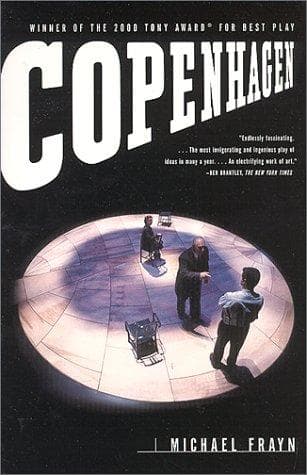
Book details and cover from Google Books.
Ready to read Copenhagen?
Get your copy on Amazon, or listen to it on Audible. We earn a commission if you buy through these links.