
We earn a commission if you buy through these links. Learn more
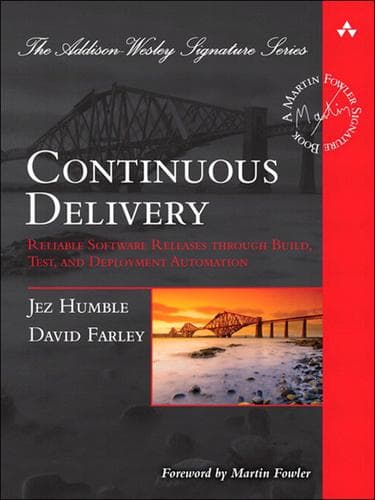
Continuous Delivery
Guide by the Books of the Day editors · Updated · How we write our guides
The definitive practical handbook for the deployment pipeline, showing how to make releases routine, low-risk, and repeatable through automation, version control, and disciplined testing.
What Creators Say About Continuous Delivery
1 creator reviewed Continuous Delivery on YouTube between 2022 and 2025, with 36.7K views between them. Their opinions are their own; we picked these reviews, we didn't write them.
What It's About
Continuous Delivery is a practical manual for getting software from a developer's commit to production quickly, repeatably, and with low risk. Humble and Farley make the deployment pipeline the spine of the book: every change is built, tested, and staged automatically, and a release becomes simply a build that has passed every gate. Most of the book concerns the machinery and habits that make this work, not any single tool.
The style is dense and methodical. It moves from principles to concrete practice: keeping everything in version control, including configuration and environments; layering automated tests at several levels; deployment strategies such as blue-green and canary releases; and handling database changes alongside application code. Examples lean on the tools of its era, and the authors are candid about trade-offs rather than offering one recipe.
Reading it feels like working through a long engineering handbook with a patient senior colleague. It rewards slow reading and a willingness to map the ideas onto your own team's pipeline. You will likely finish with a list of changes to argue for and a clearer sense that release pain is usually a process problem rather than a people problem.
Read this if you…
- own or run a release process that is slow, risky, or frequently broken and want a structured plan to fix it
- are a developer, operations engineer, or tech lead who wants shared vocabulary across teams
- prefer principles and patterns that outlast any particular tool
Skip it if you…
- want a quick hands-on tutorial with current cloud, container, or Kubernetes tooling
- work on a small or solo project where a formal deployment pipeline would be overkill
Key Ideas
- 1
The deployment pipeline as the core structure
Every change flows through a sequence of automated stages, and only builds that pass earlier stages get promoted toward production. Manual approval is kept only where human judgment truly adds value. The pipeline gives teams one visible, shared picture of what is safe to release and why.
- 2
Version control for everything, not just code
Configuration files, build scripts, environment definitions, and database scripts all belong in version control alongside application source. Treating the whole system as versioned means any past state can be reproduced on demand. This removes a large class of 'it works on my machine' failures that plague release work.
- 3
Building quality in through layered testing
The authors argue for a range of automated checks, from fast unit tests through acceptance, performance, and security tests. Fast feedback at the earliest stage is the goal, so that defects are caught when they are cheap to fix. Testing becomes a property of the pipeline rather than a phase at the end.
- 4
Separating deployment from release
Code can be deployed to production without being exposed to users, using techniques such as feature toggles, dark launches, and staged rollouts. This decouples the technical act of installing software from the business decision to turn it on. Risk drops because switching a feature on or off is far easier than redeploying.
- 5
Small, frequent changes reduce risk
Integrating and releasing in small increments makes each change easier to understand, test, and roll back. The book applies the same discipline to infrastructure and database changes, which are often the hidden source of release failures. Frequency, in this view, is a safety measure rather than a reckless speed-up.
Limitations
The book is dated. Its tooling examples reflect the early 2010s, and it predates containers, Kubernetes, and the infrastructure-as-code platforms that now shape most pipelines, so you will need to translate its advice rather than copy it. Its focus leans toward large enterprise and packaged systems, with less guidance on microservices or serverless architectures. Some readers find the prose repetitive and the thoroughness heavy going. It also says less about the organizational and cultural change needed to make these practices stick than about the technical plumbing.
Questions Readers Ask
- Is Continuous Delivery still relevant today?
- The core principles hold up well: automated pipelines, version control for everything, small changes, and separating deployment from release. The specific tools and some infrastructure patterns are dated, so pair the book with newer material on containers and cloud platforms. Humble's later work, including Accelerate, builds on many of these ideas with research data.
- How does it compare to The Phoenix Project?
- The Phoenix Project is a novel about IT operations told as a story, while Continuous Delivery is a technical handbook for building the pipeline itself. Reading Phoenix first can supply motivation and the cultural case for change, and this book then shows how to implement it. Many teams read both.
- Do I need to be a developer to read it?
- Not strictly, but the book assumes familiarity with software builds, version control, and automated testing. Operations staff, testers, and tech leads often get the most from it, because it treats release as a shared responsibility across roles rather than a developer-only concern.
- Published
- 2010
- ISBN
- 9780321670229
- Difficulty
- intermediate
- Category
- Tech
Book details and cover from Google Books.
Ready to read Continuous Delivery?
Get your copy on Amazon, or listen to it on Audible. We earn a commission if you buy through these links.