
We earn a commission if you buy through these links. Learn more
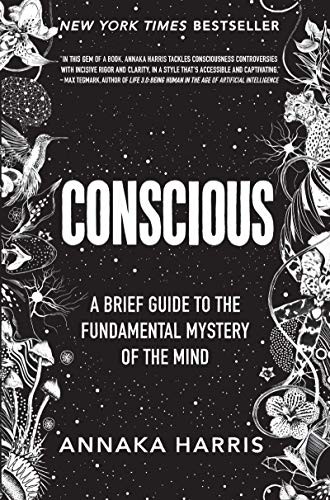
Conscious
A short, plainly written tour of the hardest question in the study of the mind, offering a clear map of why experience is so difficult to explain rather than a neat answer.
What It's About
Conscious is a short, plainly written book about the hardest question in the study of the mind: why does experience exist at all? Harris starts from the one thing nobody can dispute, the fact that they are aware, and asks how physical matter could produce that awareness. She moves through the standard puzzles without assuming that a tidy answer is waiting around the corner, and she is candid about where neuroscience has and has not gotten.
The tone is conversational and modest. Rather than building a long technical argument, Harris lays out the main positions, tests them against everyday cases like sleep, anesthesia, and the question of which animals might have experience, and invites the reader to notice where each view strains. Expect thought experiments and frank admissions of uncertainty more than footnoted debate. The writing rewards slow reading, because much of the value is in pausing over a question you have probably never examined closely.
Reading it is less like absorbing a finished theory and more like being walked through a problem. You will leave with a sharper sense of why the question is hard, not with a solved mystery. That is the book's real offer: a clear map of a puzzle, written for people who have never taken a philosophy of mind course.
Read this if you…
- want a short, accessible introduction to the hard problem of consciousness
- are curious about why science has trouble explaining subjective experience
- prefer being led through a question to being handed a finished theory
Skip it if you…
- want a definitive answer or a single theory that solves consciousness
- need a rigorous, technical treatment with detailed experimental evidence
Key Ideas
- 1
Experience is the one thing we know directly
Everything we know about the world reaches us through our own awareness, yet we rarely treat that awareness as the strange fact it is. Harris uses this starting point to show that consciousness is not one more object of study that can be observed from outside. Its felt quality is available only from within, which is why it resists the usual methods of science.
- 2
Why physical explanations seem to leave something out
Neuroscience can map which brain processes correlate with seeing red or feeling pain, but a map of correlations does not obviously explain why those processes feel like anything. This gap between describing function and explaining experience is the core difficulty the book keeps returning to. Harris makes the gap concrete so that a skeptical reader can see the problem without needing specialist vocabulary.
- 3
Competing answers, each with a real cost
The book surveys the major families of response: views that deny the problem is deep, views that give experience a place in all matter, and views that treat consciousness as something that emerges from complex systems. Each option solves one difficulty while creating another. Harris lays out these trade-offs fairly and does not pretend that any one of them has won.
- 4
Taking uncertainty seriously as a position
A recurring theme is that our current concepts may simply be inadequate to the question. Harris argues that admitting this is not a failure of nerve but a legitimate intellectual stance. For readers used to confident popular science, this humility can feel unsatisfying, though it is also the book's most honest feature.
Limitations
Because the book is brief, it necessarily skims many positions and arguments that specialists treat at length. Readers who already know the philosophy of mind may find the survey thin and the examples familiar. Some will also feel the book stops short of committing to a view, which can read as evasive if you were hoping for a clear conclusion. Its value lies in clarity and accessibility, not in depth of argument or new evidence.
Questions Readers Ask
- Is Conscious a good first book on the mind?
- Yes, it is one of the more approachable entry points into the question of consciousness. It is short, avoids jargon where it can, and explains why the problem is hard before asking you to weigh answers. Readers who want more depth afterward can move to more technical philosophy or neuroscience with a clearer sense of what is at stake.
- How does it compare to Christof Koch or Daniel Dennett?
- Harris's book is much shorter and gentler than Dennett's Consciousness Explained, which is dense and argues a specific position. Compared with Koch's work, which draws heavily on neuroscience research, Conscious focuses more on framing the question and surveying the options. It suits readers who want orientation rather than an argument or a research program.
- Published
- 2019
- ISBN
- 9781982659455
- Difficulty
- beginner
- Category
- Psychology
Book details and cover from Google Books.
Ready to read Conscious?
Get your copy on Amazon, or listen to it on Audible. We earn a commission if you buy through these links.