
We earn a commission if you buy through these links. Learn more
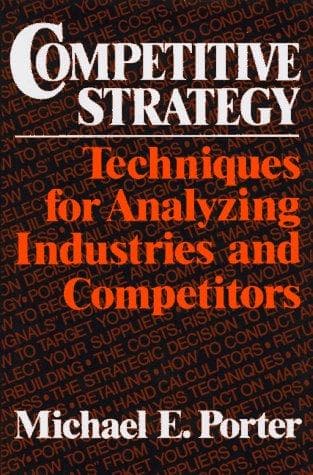
Competitive Strategy
Porter's classic gives managers a systematic way to judge how attractive an industry is and where a firm should position itself, using frameworks that still shape strategy courses.
What It's About
Competitive Strategy argues that a company's profitability depends heavily on the structure of the industry it competes in, and that the core job of strategy is to find a defensible position inside that structure. Porter's central tool is a way of analyzing an industry: who the rivals are, how much power buyers and suppliers hold, how easily newcomers can enter, and whether substitutes threaten the product. The book turns these forces into a repeatable method rather than a collection of anecdotes.
The writing is that of a professor building a toolkit. Expect many diagrams, checklists, examples drawn from real industries, and careful definitions. It reads more like a reference work than a narrative, so it rewards a slow read with a pen in hand. Some sections are dense and repetitive, and you will skim parts of it, but the core frameworks are clear once you see them laid out.
Reading it changes how you look at a market. You start asking why some industries are consistently profitable while others never are, and what a rival's next move is likely to be. It is less a book of inspiration or war stories than an analytical manual, and it works best for people who want to reason through a competitive problem step by step.
Read this if you…
- want a structured method for analyzing an industry before choosing a strategy
- are studying business strategy and need the foundational frameworks behind later courses
- run or advise a firm and want to understand why some markets are more profitable than others
Skip it if you…
- want a narrative business story or a memoir of a famous company
- are looking for quick, practical playbooks with templates for immediate execution
Key Ideas
- 1
Five forces shape industry profitability
Porter identifies five pressures that determine how much profit an industry can sustain: the threat of new entrants, the bargaining power of suppliers, the bargaining power of buyers, the threat of substitutes, and rivalry among existing competitors. Strong forces squeeze margins, weak ones leave room to earn more. The framework is useful because it forces you to look at the whole market, not just your immediate competitors.
- 2
Three generic strategies: cost, differentiation, focus
A firm can pursue overall cost leadership, differentiate its product in ways customers value, or concentrate on a narrow segment. Porter argues that firms which fail to commit clearly to one of these, the ones stuck in the middle, tend to earn below-average returns. The idea pushes managers to make an explicit choice about where they will win rather than trying to do everything at once.
- 3
Analyzing rivals and anticipating their moves
Porter treats competitor analysis as a discipline in its own right. He suggests looking at a rival's current strategy, its goals, its assumptions about the industry, and its capabilities to predict how it will respond to your moves. The method is practical: it asks you to build a profile of each important competitor before deciding what to do.
- 4
Strategic groups and barriers to mobility
Companies in the same industry often cluster into strategic groups that compete in similar ways, and moving from one group to another is hard. Porter explains how barriers to mobility, such as scale, brand, or distribution, keep firms in their lanes. Seeing the map of groups helps a manager spot where competition is intense and where room remains.
- 5
Industry evolution and changing structure
Industries are not static, and their structure shifts as they grow, mature, and decline. Porter shows how changes in growth, technology, buyer knowledge, and cost patterns alter the five forces over time. A strategy that works in the early stage of a market can become a liability later, so the analysis must be repeated as conditions change.
Limitations
The book is written for a 1980 audience and its examples come mostly from manufacturing and industries of that era, so some cases feel dated. Its view is largely static and industry-centric, giving less attention to how a firm's internal resources and capabilities can drive advantage, a perspective later developed by resource-based theorists. Critics also note that the frameworks can be applied after the fact more easily than used to predict outcomes. Porter's later work extended many of these ideas, so readers may want to pair this book with his follow-up.
Questions Readers Ask
- Is Competitive Strategy still relevant today?
- Yes, the five forces and generic strategies remain standard tools in business education and consulting. The specific examples are dated and the book does not address digital platforms or network effects in depth. Many readers use it as a foundation and then supplement it with more recent work on platforms and capabilities.
- Do I need a business background to read it?
- Not strictly, but some familiarity with basic economics, such as pricing, costs, and market competition, helps. The prose is clear enough for a motivated general reader, though the dense sections and repeated frameworks can feel slow without a practical problem in mind.
- Published
- 1980
- ISBN
- 9780029253601
- Difficulty
- intermediate
- Category
- Business
Book details and cover from Google Books.
Ready to read Competitive Strategy?
Get your copy on Amazon, or listen to it on Audible. We earn a commission if you buy through these links.