
We earn a commission if you buy through these links. Learn more
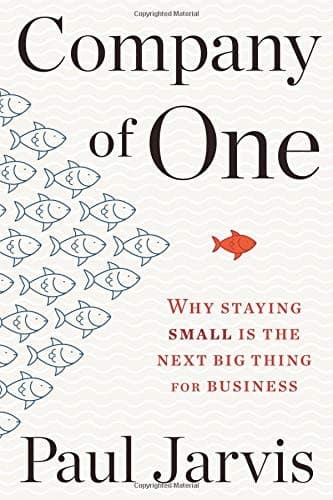
Company of One
by Paul Jarvis
Guide by the Books of the Day editors · Updated · How we write our guides
Paul Jarvis makes a practical case for keeping a business small on purpose, prioritizing stability, autonomy, and a life you control over endless growth. It is a useful counterweight to startup advice.
What Creators Say About Company of One
2 creators reviewed Company of One on YouTube between 2019 and 2022, with 85.1K views between them. Their opinions are their own; we picked these reviews, we didn't write them.
What It's About
Company of One is a business book that questions the assumption that every company should grow as large as possible. Jarvis argues that many owners would be better off building a business that is stable, profitable, and comfortable to run for years, rather than one designed to raise money, scale quickly, and eventually be sold or go public. He presents "enough" as a legitimate goal and treats a small operation as a deliberate choice, not a failure to think bigger.
The book reads like a conversation with an experienced small-business owner rather than a textbook. Jarvis draws on his own work running a small company and on the patterns he has seen among independent operators, and he is direct about the trade-offs. The tone is plain and opinionated, and the chapters tend to circle back to a few core questions: what do you actually need, who are your customers, and how much of your life do you want your work to take up?
Reading it is less like studying a method and more like being asked to reconsider your goals. The ideas are easy to follow, and the book is short enough to finish in an afternoon or two. Its value comes from the questions it forces you to answer honestly, which matter more than any single tactic. Readers who want detailed operational playbooks may find it thin, but those weighing whether growth is worth the cost will find it clarifying.
Read this if you…
- are running or planning a small business and feel pressure to scale it up
- are tired of startup advice that treats growth as the only measure of success
- want to decide what success means for you before setting business goals
Skip it if you…
- are looking for detailed marketing, finance, or hiring tactics for a growing company
- are building a venture-backed startup and need guidance on fundraising and scaling
Key Ideas
- 1
Growth is a choice, not a default
Jarvis challenges the idea that a business must always expand to be successful. He suggests that growth brings real costs in money, stress, and loss of control, and that owners should decide deliberately whether those costs are worth paying rather than assuming they are inevitable.
- 2
Defining what 'enough' means for you
A central theme is setting a clear target for income, workload, and lifestyle before making business decisions. Once you know what enough looks like, it becomes easier to turn down opportunities that would push you beyond it, and easier to judge whether the company is succeeding by your own standards.
- 3
Serving a small number of customers well
Jarvis emphasizes depth over breadth: building strong relationships with a manageable group of customers and focusing on what they value. He argues this creates more durable income than chasing the largest possible market, and that loyalty often matters more than reach.
- 4
Stability as a competitive advantage
The book presents a modest, sustainable business as a strength rather than a compromise. A company that does not depend on constant outside funding or aggressive expansion can weather downturns, keep its independence, and make decisions based on what serves its owner and customers.
- 5
Autonomy and quality of life
Throughout, Jarvis returns to the personal side of running a business: time, freedom, and the ability to shape your own work. He treats these as legitimate measures of success and argues that they are often sacrificed without much thought in pursuit of growth metrics.
Limitations
Some readers find the argument one-sided, since it leans heavily on the author's own experience and on a view of small business that can downplay the value of employees, expansion, and ambition. Jarvis's advice assumes a degree of financial cushion and market access that not every owner has. The book also offers limited operational detail, so it works better as a mindset guide than a how-to manual, and some of its examples reflect the online service business of its time.
Questions Readers Ask
- Is Company of One only for freelancers?
- No, although freelancers and solo operators will find it especially relevant. Jarvis writes about small businesses more broadly, including companies with a few employees. The core question of how big a business should be applies to any owner who is choosing between growth and sustainability.
- How does it compare to The E-Myth Revisited?
- The E-Myth focuses on systematizing a business so it can run without the owner, which is a structural and operational approach. Company of One is more about the owner's goals, the value of staying small, and rejecting growth as the default. Readers often use the two together, one for systems and the other for purpose.
- Published
- 2019
- ISBN
- 9780241380239
- Difficulty
- beginner
- Category
- Business
Book details and cover from Google Books.
Ready to read Company of One?
Get your copy on Amazon, or listen to it on Audible. We earn a commission if you buy through these links.