
We earn a commission if you buy through these links. Learn more
Comfortable with Uncertainty
by Pema Chödrön
A gentle, practical guide to staying present with fear and discomfort instead of running from them, offering Buddhist ideas in plain, warm language that works in small daily doses.
What It's About
Comfortable with Uncertainty is a collection of short teachings by Pema Chödrön, an American-born Buddhist nun and longtime student of Chögyam Trungpa, drawn from her talks. Rather than building one continuous argument, it circles around a single question: what do we do when life refuses to hold still? The book is organized as numbered teachings of a few pages each, and most readers will dip in and out rather than read straight through.
Chödrön's central move is to treat fear, restlessness, and discomfort not as problems to be eliminated but as the raw material of practice. She draws on Tibetan Buddhist mind-training traditions, especially the idea of shenpa, the sticky hook of attachment that makes us grab at comfort and push away everything else. The tone is conversational, blunt, and warm, with many everyday examples and very little specialist vocabulary.
Reading it feels less like studying a doctrine and more like sitting with a patient teacher who keeps turning you back toward your own mind. Some passages land at once; others restate a point in new words, which is part of the design. Expect to read slowly, put the book down, and return to it. It asks for honesty and self-observation rather than belief, which is why it has found readers well beyond formal Buddhist communities.
Read this if you…
- want a calm, honest companion for anxiety about an uncertain future
- like short, self-contained readings you can pick up for ten minutes at a time
- are curious about Buddhist ideas explained without heavy jargon or ritual
Skip it if you…
- want a structured, step-by-step method with clear milestones
- are looking for a secular self-help book with no spiritual framing
Key Ideas
- 1
Groundlessness as the starting point
Chödrön argues that life offers no permanent ground to stand on, and that trying to build security out of certainty keeps us stuck. Seeing this clearly, rather than denying it, is presented as the beginning of a steadier way to live. The idea recurs throughout and gives the book its title and direction.
- 2
Shenpa and the habit of getting hooked
Shenpa describes the moment we feel a pull toward or away from something and reflexively act on it. Chödrön shows how these hooks drive anger, craving, and self-justification. The practical lesson is to notice the hook early, before the story around it takes over.
- 3
Staying with discomfort instead of escaping
Much of the book encourages the reader to remain present with uncomfortable feelings rather than reaching for distraction or blame. The emphasis is on patience and direct experience, not on reaching a calm state. Chödrön frames this as a skill that grows with repetition.
- 4
Compassion practices such as tonglen
Tonglen is a meditation of breathing in others' pain and breathing out relief, and the book uses it to show how compassion can grow from our own difficulties. Chödrön presents such practices as ordinary tools for everyday relationships, not as acts of heroic saintliness.
Limitations
Because the book is built from talks, it repeats itself, and some readers will find the teachings soft or circular across a long read. Its Buddhist framing is central rather than decorative, so readers who want a secular approach may feel they are being steered toward a worldview. It offers few concrete exercises beyond brief practices, and it does not engage with clinical research on anxiety or trauma. Those needing specific psychological treatment should look elsewhere.
Questions Readers Ask
- Is Comfortable with Uncertainty good for people who are not Buddhist?
- Yes, many readers outside Buddhism find it useful because Chödrön speaks in everyday language about fear, anger, and relationships. The Buddhist sources are present but usually explained rather than assumed. Readers who are put off by religious framing may still find the core ideas about attention and self-awareness helpful, though they should expect the spiritual context to remain.
- How does it compare to When Things Fall Apart by the same author?
- When Things Fall Apart is more sustained and cohesive, with a clearer arc through the ideas of suffering and impermanence. Comfortable with Uncertainty is looser and more episodic, making it easier to read in short pieces. Many readers start with the earlier book for depth and return to this one as a companion for daily reflection.
- Published
- 2002
- ISBN
- 9781590306260
- Difficulty
- beginner
- Category
- Doctrines
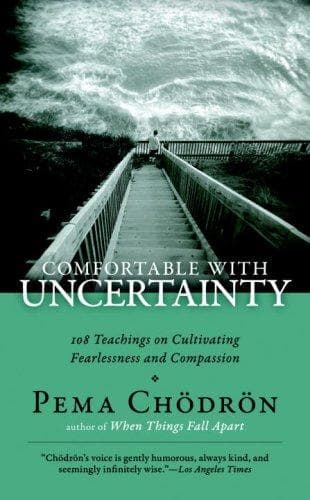
Book details and cover from Google Books.
Ready to read Comfortable with Uncertainty?
Get your copy on Amazon, or listen to it on Audible. We earn a commission if you buy through these links.