
We earn a commission if you buy through these links. Learn more
Code talker
by Joseph Bruchac, Derrick Henry
Guide by the Books of the Day editors · Updated · How we write our guides
A Navajo Marine's first-person account of World War II, showing how a language never written down became one of the war's most effective secrets.
What Creators Say About Code talker
2 creators reviewed Code talker on YouTube in 2025, with 450 views between them. Their opinions are their own; we picked these reviews, we didn't write them.
What It's About
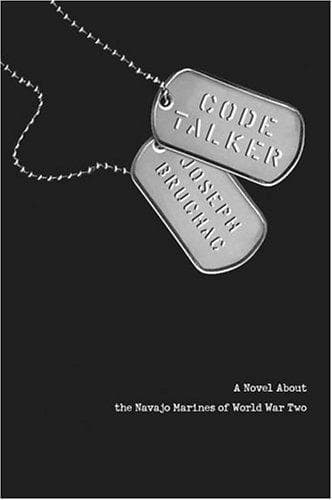
Code Talker is a novel for younger readers by Joseph Bruchac that follows a Navajo young man through the years when his schooling, his language, and his loyalty to the United States all pull in different directions. He is one of the Navajo Marines who used their native language to send tactical messages across the Pacific, a code the enemy never managed to decipher. The book is narrated in the first person, so the war arrives through one character's memory, with thoughts of home and school sitting beside the fighting.
The style is plain and direct, closer to a memoir than a thriller. Much of the pleasure lies in the texture: the sound of the Diné language, the working rules of the code, and the way a young soldier learns to hold two worlds at once. Combat is present and not softened for its audience, but the book gives as much attention to prejudice, homesickness, and the long wait for public recognition of what the code talkers did.
Reading it feels like sitting with an older relative who has decided, finally, to tell the whole story. It is short enough to finish in one sitting or two, and it suits a reader who wants a serious historical story without heavy military detail.
Read this if you…
- want a short, emotionally direct historical novel
- are curious about Native American experience during World War II
- want an accessible entry point into Pacific war history for younger readers
Skip it if you…
- want a detailed, battle-by-battle military history
- prefer fast-paced action or intricate plotting
Key Ideas
- 1
A language as a weapon
The code worked because Diné was spoken by very few outsiders and had no written form to study. The novel shows how a tool of survival was also the very thing the boarding school had tried to beat out of Ned and his classmates. The irony gives the story much of its force, and it asks readers to consider how a culture's strengths can be overlooked until a crisis demands them.
- 2
Loyalty to a country that doubts you
Ned fights for a nation that treats him as less than a full citizen at home. The book does not resolve this tension neatly. Instead it lets the reader feel how service and suspicion can exist side by side, and how a young man might keep his sense of duty while his own rights remain uncertain.
- 3
War seen by a teenager
The narration keeps close to the sensations and confusions of a very young man, not the strategy of generals. Routine, fear, friendship, and sudden violence are shown at a human scale. This makes the historical events feel immediate without relying on dramatic plotting.
- 4
History kept secret for decades
The code talkers' work stayed classified for many years after the war, so their families and communities often learned its scope late. The novel functions partly as a record of that silence and of the belated recognition that followed. Readers come away understanding why the story needed telling.
Limitations
Written for younger readers, the book handles violence with restraint, which some adults will find too gentle for the realities it describes. Because the story follows one narrator, it cannot represent the full range of Navajo code talkers' experiences, and readers should not treat Ned as typical. Some critics have also noted that an outside author writing about Navajo life and language can only offer so much insider texture. Historical details are compressed for pacing, so it works better as an introduction than as a reference.
Questions Readers Ask
- Is Code Talker suitable for adults, or only for children?
- It is written for younger readers, but many adults read it with pleasure. The sentences are clear and the chapters are brief. Adults who want the deeper historical context will likely want to pair it with nonfiction sources about the Navajo code talkers, since the novel is an introduction rather than an exhaustive account.
- Is the story historically accurate?
- The code and the Navajo Marines who used it are real history. Ned Begay is a fictional character, though, so his specific experiences should not be read as documented fact. For dates, battles, and the official record of the code talkers, consult dedicated nonfiction histories alongside the novel.
- Published
- 2005
- ISBN
- 9780142405963
- Difficulty
- beginner
- Category
- Children's Books
Book details and cover from Google Books.
Ready to read Code talker?
Get your copy on Amazon, or listen to it on Audible. We earn a commission if you buy through these links.