
We earn a commission if you buy through these links. Learn more
Civilisation
Guide by the Books of the Day editors · Updated · How we write our guides
A personal, opinionated tour of Western art and its moods, built around the images and voice of a gifted guide who makes you look harder.
What Creators Say About Civilisation
2 creators reviewed Civilisation on YouTube between 2013 and 2024, with 167.1K views between them. Their opinions are their own; we picked these reviews, we didn't write them.
What It's About
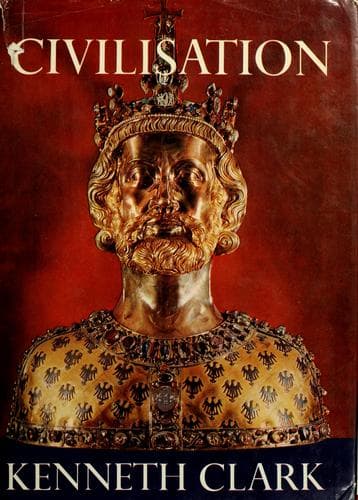
Civilisation is the book of Kenneth Clark's 1969 BBC television series, a survey of Western art and thought from the early Middle Ages to the twentieth century. Clark, a former director of the National Gallery, does not try to be exhaustive. He moves through a sequence of cathedrals, paintings, sculptures and buildings, using each to ask what the people who made them believed and felt, and whether they were confident enough to make something lasting.
The style is the main attraction. Clark writes in a conversational, first-person voice that is opinionated, warm and often wry, and he is openly unembarrassed about preferring some periods and artists to others. The text reads like a long talk by someone who has looked at these objects for decades and wants you to see what he sees. The book is heavily illustrated in most editions, and the pictures do much of the work, so it rewards slow reading with the images beside you.
The experience is less like studying a textbook than like being guided through a museum by an enthusiastic, slightly old-fashioned expert. You will finish with a sharper sense of why certain eras felt vital and others felt bleak, and with a list of things to go and look at. You will not finish with a complete history of anything, and that is by design. Clark is interested in peaks and in the conditions that produced them.
Read this if you…
- want an accessible, opinionated tour of Western art and the moods of its historical periods
- enjoy an author's distinctive voice more than a neutral, encyclopaedic survey
- are planning gallery visits or want to look at familiar paintings and buildings with fresh eyes
Skip it if you…
- need a rigorous, up-to-date account of Western history or current art scholarship
- want global coverage, since the book is centred on Europe and its inheritance
Key Ideas
- 1
Civilisation as a state of mind
Clark's central claim is that civilisation depends less on wealth, technology or political stability than on a society's confidence in itself, its willingness to believe in order, reason and human dignity. Barbarism, in his account, is often a failure of nerve rather than a shortage of resources.
- 2
Art as evidence of belief
Clark reads paintings, buildings and sculpture as direct records of what a culture cared about. A cathedral or a portrait becomes a way into the thinking of its time rather than a decorative object, and the book trains you to ask what an image assumes its viewer already believes.
- 3
The role of heroic individuals
Clark gives real weight to exceptional makers and thinkers, figures he sees as carrying a civilisation's energy forward. This is where his approach is most personal and most debated, since it places great emphasis on a small number of genius-level names.
- 4
Cycles of confidence and collapse
He tracks alternating periods of creative confidence and anxiety, showing how crises and violence recur and how cultures recover. The tension between order and disorder runs through the whole argument and gives the chapters a sense of narrative momentum.
- 5
A deliberately subjective canon
The selection is centred on Western Europe and reflects Clark's own taste. He makes no claim to neutrality, which is part of the book's charm and part of its problem, and the reader is invited to argue back rather than simply absorb.
Limitations
The book is firmly Eurocentric and male-dominated in its selection of makers, and it largely ignores art and thought outside Western Europe apart from passing mentions. Clark's confidence in his own judgment of quality now reads as dated to many readers, and his assumptions about progress and the civilised have been challenged by later historians. Scholarship on medieval and modern art has moved well beyond his account, and the later material feels thinner than the earlier sections. Treat it as a period piece with lasting insight rather than a final verdict.
Questions Readers Ask
- Is Civilisation still worth reading today?
- Yes, mainly for the voice and for the way Clark makes you look hard at images. Many of his facts and judgments have aged, and specialists have revised much of what he says. Read it as an intelligent, personal introduction that points toward further reading, not as the last word on Western art.
- How does it compare with John Berger's Ways of Seeing?
- Berger's 1972 book is shorter, sharper and openly political, questioning how images are used to show power and possession. Clark is warmer, more traditional and more interested in quality and genius. Readers who want a critical counterpoint to Clark often pair the two.
- Do I need to know art history first?
- No. Clark writes for a general audience and explains terms as he goes. Some background helps, but the book is designed for curious viewers rather than specialists.
- Published
- 1969
- ISBN
- 9780060907877
- Difficulty
- beginner
- Category
- History
Book details and cover from Google Books.
Ready to read Civilisation?
Get your copy on Amazon, or listen to it on Audible. We earn a commission if you buy through these links.