
We earn a commission if you buy through these links. Learn more
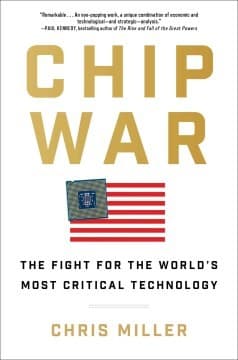
Chip War
Guide by the Books of the Day editors · Updated · How we write our guides
A clear, well-sourced history of how semiconductors became the foundation of the modern economy and a geopolitical flashpoint, told through the companies and governments that shaped the industry.
What Creators Say About Chip War
2 creators reviewed Chip War on YouTube between 2024 and 2025, with 1M views between them. Their opinions are their own; we picked these reviews, we didn't write them.
What It's About
Chip War traces the history of the integrated circuit from its invention in the late 1950s to the present, arguing that the chip industry became one of the most consequential arenas of economic and military competition. Miller is less interested in engineering detail than in the decisions: who funded research, which governments subsidized factories, which firms bet on the wrong technology, and how supply chains spread across the United States, Japan, South Korea, Taiwan, and China.
The narrative moves in roughly chronological order and is built around a handful of recurring figures and companies rather than a parade of inventors. Readers meet executives, engineers, and state planners whose choices reshaped the field, and the book keeps returning to a central point: manufacturing know-how is hard to replicate, and it concentrates in a few places. The prose is brisk and explanatory, with analogies that make process technology legible to non-specialists.
Reading it feels like following a long strategic briefing crossed with industrial history. The tone is measured rather than alarmist, though the later chapters carry a sense of urgency about export controls and Taiwan's position. It is accessible to general readers, but it assumes you are willing to track a large cast and several decades of shifting alliances. Expect corporate rivalries and policy maneuvering; it rewards attention more than speed.
Read this if you…
- want a grounded explanation of why chips matter to trade policy and national security
- are interested in business history and how firms like Intel and TSMC took very different paths
- want context for the US-China technology rivalry beyond headlines
Skip it if you…
- want a technical explanation of how transistors or lithography actually work
- prefer books focused on the consumer products or software that run on top of chips
Key Ideas
- 1
Chips as the infrastructure of modern power
Miller makes the case that semiconductors are no longer just components inside electronics. They underpin military systems, financial networks, and nearly every industrial process, which is why governments that once ignored them now treat chip supply as a matter of national security. The book uses this shift to explain why a niche manufacturing business drew so much political attention.
- 2
Manufacturing knowledge matters more than design
A central thread is that designing a chip and making one at the cutting edge are very different skills. Fabrication depends on accumulated process knowledge, yield improvement, and tightly coordinated equipment suppliers. Miller shows how this know-how concentrated in a few firms and sites, and why that concentration is hard to undo quickly.
- 3
Government industrial policy shaped the winners
The book shows that market forces alone did not decide the industry's map. Japan's push into memory chips, the state-backed rise of South Korean and Taiwanese firms, and China's large, sustained investment programs each reflected deliberate choices. Miller treats these policies as central to who ended up leading, not as footnotes to private competition.
- 4
Geography and supply chains as strategic risk
The later sections focus on how a supply chain spread across continents can become a point of leverage. Export controls, dependence on a small number of advanced foundries, and the strategic position of Taiwan are presented as the reasons chips have become a diplomatic instrument. The argument is about vulnerability as much as about technology.
Limitations
The book is centered on the United States and East Asia, and some readers find the Chinese perspective less developed than the rest of the story. Its engineering explanations are simplified on purpose, which suits general readers but may frustrate specialists. Because it was written before the recent surge in AI-driven demand for advanced processors and the tightening of export rules that followed, parts of its policy analysis feel dated and should be supplemented with current reporting.
Questions Readers Ask
- Do I need a technical background to read Chip War?
- No. Miller explains the key manufacturing concepts in plain language and focuses on business and policy decisions rather than physics. A general reader with an interest in economics or current affairs can follow it without trouble, though keeping track of the many companies and governments takes some attention.
- Is Chip War still relevant given the AI chip boom?
- The historical framework still holds, since the same concentration of manufacturing and the same government interventions drive today's situation. However, the book predates much of the recent AI-driven demand and later export restrictions, so it is best read as foundation material alongside newer analysis.
- How does Chip War compare to The Idea Factory?
- Jon Gertner's The Idea Factory focuses on the research culture of Bell Labs and how invention happened inside one institution. Chip War is broader and more geopolitical, asking how industrial strategy and national rivalry shaped the chip industry. Readers who want the science-and-people story may prefer Gertner, while those interested in power and policy will likely prefer Miller.
- Published
- 2022
- ISBN
- 9781982172015
- Difficulty
- intermediate
- Category
- Business
Book details and cover from Google Books.
Ready to read Chip War?
Get your copy on Amazon, or listen to it on Audible. We earn a commission if you buy through these links.