
We earn a commission if you buy through these links. Learn more
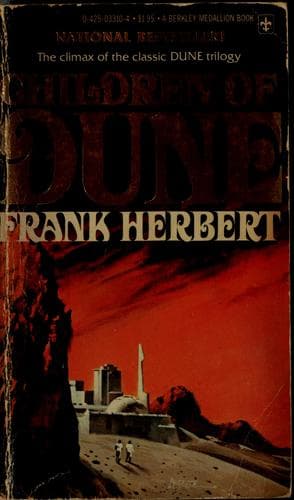
Children of Dune
Herbert's politically tense sequel to Dune, where a ruling family's inherited power and its costs come home to the twins at its center.
What It's About
Children of Dune picks up several years after the events of Dune Messiah, with the Fremen homeland still living under the weight of a jihad that Paul Atreides set in motion. The story follows his twin children, Leto and Ghanima, as they grow up inside a court full of schemers, religious zealots, and old loyalties. Herbert is less interested in battles here than in the machinery of power: who controls the water, the spice, and the stories people tell about their leaders.
The book is dense and talky. Much of the action happens in conversation, in private councils, and inside characters' heads, where Herbert plants his usual warnings about how prophecy and religion can be turned into weapons. The prose is more reflective than the first novel's, and it often moves in long stretches of argument before a sudden jolt of violence or revelation. Readers who enjoy watching characters outmaneuver one another will find a lot to chew on.
Reading it feels like sitting inside a long, uneasy negotiation. The pleasure comes from watching the pieces slowly line up, and from noticing how each character's choices reflect the larger problem of inheriting a myth you did not write. It works best as the middle movement of the saga and as a bridge toward the stranger books that follow.
Read this if you…
- Finished Dune and want to see how its political world holds together after the central hero is gone
- Enjoy slow, argumentative fiction where the tension comes from people maneuvering around each other
- Are interested in how religion, prophecy, and inherited myth shape real political decisions
Skip it if you…
- Came for the desert battles and sandworm spectacle of the first novel and find long council scenes tedious
- Want a self-contained story with a clean arc, since this book is a deliberate middle chapter
Key Ideas
- 1
Power that outlives its founder
The novel asks what happens when a leader's legend is larger than the leader. Paul is dead or absent in practice, yet his name still moves armies and shapes decisions. The twins must decide whether to honor that legacy, resist it, or quietly rewrite it, and each option carries a political cost.
- 2
Religion as a tool of control
Herbert keeps returning to how belief can be organized, exploited, and turned against the people who created it. Prophecy here is never simply true or false. It is a resource that different factions use to justify violence, win loyalty, and protect their own interests.
- 3
Prescience and the burden of knowing
Several characters can glimpse possible futures, and the book treats this gift as a kind of trap. Foreknowledge narrows choices rather than widening them, and Herbert uses it to examine how responsibility feels when you can see where paths lead but cannot easily leave them.
- 4
Ecology and the cost of resources
Arrakis remains a planet where water and the spice define every relationship. The political plots are tied to who gets to use this scarce world and how its environment is managed, which keeps the ecological theme of the first novel alive in quieter, more bureaucratic form.
Limitations
Children of Dune is often criticized for its pacing. Long stretches of dialogue and interior reflection can feel repetitive, and some of Herbert's philosophical passages read more like lectures than scenes. The book's gender and cultural portrayals reflect the 1970s and can seem dated, particularly in how women's roles and power are framed. It also ends by setting up later volumes rather than resolving everything, which some readers find unsatisfying on its own terms.
Questions Readers Ask
- Do I need to read Dune Messiah before Children of Dune?
- Yes, in practice you should. Children of Dune assumes you know the political situation Paul left behind and the fates of the characters who survived the earlier books. Starting here would leave you with too many unexplained names and alliances, and the emotional stakes would not land the way Herbert intends.
- Is Children of Dune still worth reading today?
- For many readers, yes. Its concerns about charismatic leaders, religious movements, and the abuse of prophecy remain relevant. The pacing and some attitudes feel older than the story's ideas, so it rewards patience more than fast reading. Readers who value political depth will likely find it more rewarding than the average sequel.
- Published
- 1976
- ISBN
- 9789759971342
- Difficulty
- intermediate
- Category
- Fiction
Book details and cover from Google Books.
Ready to read Children of Dune?
Get your copy on Amazon, or listen to it on Audible. We earn a commission if you buy through these links.