
We earn a commission if you buy through these links. Learn more
Chicken Soup with Rice
A short, rhythmic picture book that works as a read-aloud for young children, with twelve seasonal verses and one repeated refrain; it is not a cookbook despite its shelf category.
What It's About
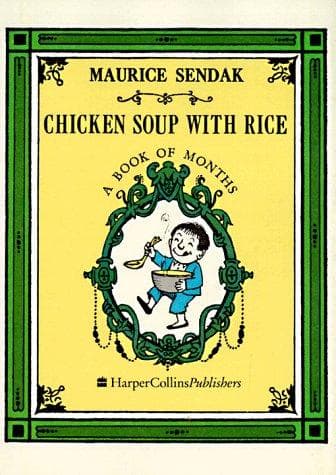
Chicken Soup with Rice is a brief picture book by Maurice Sendak, first published in 1962. Despite the Cooking category, it contains no recipes and gives no instructions for making soup. It is a set of twelve rhyming poems, one for each month of the year, and each one ends on the same refrain about chicken soup with rice, linked to that month's weather, holidays, and mood.
The approach is built on rhythm and repetition. Sendak's verses are meant to be read aloud, and the singsong meter and returning line give small children a pattern they can anticipate and chant along with. The illustrations carry much of the emotional range, moving from winter scenes to summer ones and tying each month's images back to the rhyme.
Reading it takes only a few minutes, and it works best as a shared experience with a child rather than a text to study closely. Adults may approach it nostalgically, and older readers can appreciate Sendak's playful handling of language and the way a simple repeated image can mark the turning of a year.
Read this if you…
- want a short, rhythmic book to read aloud with a young child
- enjoy seeing how a simple refrain can structure an entire year
- are curious about Maurice Sendak's work before his best-known titles
Skip it if you…
- want actual recipes or cooking instructions, since this book has none
- are looking for a substantial story or nonfiction with extended ideas
Key Ideas
- 1
A year measured by one dish
The book uses a single food as a fixed point while the months change around it. Because the refrain never varies, the reader notices what shifts: the light, the activities, the feeling of each season. It is a compact lesson in how a steady routine can frame changing time.
- 2
Rhythm and refrain as the engine
The verses are designed for the mouth as much as the eye. The meter is regular and the closing line returns in every month, so children learn the pattern quickly and can join in. Much of the pleasure comes from hearing the text out loud rather than reading it silently.
- 3
Seasons as mood, not just scenery
Each month gets more than a weather report. Sendak's images and lines suggest how the time of year feels, from cold, indoor months to brighter, outdoor ones. Readers who look past the surface will see that the book is quietly about moods and expectations.
- 4
An early look at Sendak's voice
This book appeared before Where the Wild Things Are, so it offers a glimpse of the playful, rhythmic, child-centered approach Sendak would develop further. Readers interested in his career will find the book useful as an early example of his style.
Limitations
The book is very short and its emotional and narrative range is narrow, so older readers may find it slight. Its category label is misleading for anyone expecting a cookbook. Some of the scenes and attitudes reflect the early 1960s, and the repetition that delights small children can feel monotonous to adults reading it alone. It also offers little explanation of its images or context, so readers who want deeper commentary will need to look elsewhere.
Questions Readers Ask
- Is Chicken Soup with Rice a cookbook?
- No. Although it is listed under Cooking, it is a picture book of twelve rhyming poems, one for each month. Each poem ends on a refrain about chicken soup with rice, but the book gives no recipe or cooking method. If you want a recipe, you will need a different title.
- Who is this book best for?
- It suits toddlers and young children, especially as a read-aloud, and parents or teachers who want a short rhythmic text. Adults who enjoy Sendak's early work or children's poetry will also find it charming. Readers looking for a complex story or deep argument should choose something else.
- How does it compare to Where the Wild Things Are?
- Both are short picture books by Sendak that rely on rhythm and strong illustrations for children. Chicken Soup with Rice is quieter and more structured, built on a seasonal refrain, while Where the Wild Things Are has a fuller narrative arc and more dramatic emotion. Many readers start with the better-known book and find this one a gentler companion.
- Published
- 1962
- ISBN
- 9780590454520
- Difficulty
- beginner
- Category
- Cooking
Book details and cover from Google Books.
Ready to read Chicken Soup with Rice?
Get your copy on Amazon, or listen to it on Audible. We earn a commission if you buy through these links.