
We earn a commission if you buy through these links. Learn more
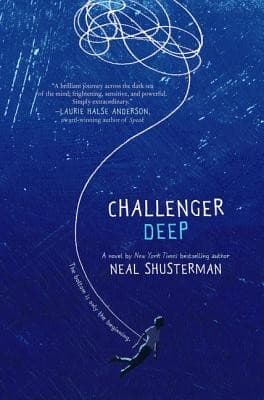
Challenger Deep
Guide by the Books of the Day editors · Updated · How we write our guides
Shusterman's inventive YA novel splits a teenager's mind between a psychiatric ward and a submarine voyage, making mental illness feel immediate and disorienting.
What Creators Say About Challenger Deep
2 creators reviewed Challenger Deep on YouTube between 2015 and 2016, with 15.9K views between them. Their opinions are their own; we picked these reviews, we didn't write them.
What It's About
Challenger Deep follows Caden Bosch, a teenager who is being treated in a psychiatric unit, through two intertwined realities. In the hospital he is a patient working through a difficult diagnosis and the people around him. In the other, he is a crew member aboard a vessel descending toward the Challenger Deep, the deepest known point of the ocean. Aboard the ship, his captain and shipmates feel as real to him as the nurses and doctors do to the reader, and the tension between the two worlds drives the story.
Shusterman alternates chapters between the hospital and the voyage, and the shifts are built to leave you unsure which version of events to trust, much as Caden is. The book does not stop to explain itself. Its prose is clean and fast, and the chapters are short, which keeps momentum up even when the logic of each setting bends.
This is a book about perception more than plot. Readers come away with a clearer sense of what it feels like to lose trust in your own mind, and of how family and caregivers experience that from the outside. It is emotionally heavy but written for young adults, so it reads as accessible rather than clinical. The experience is less like solving a mystery and more like spending a few hundred pages inside someone else's head.
Read this if you…
- want a YA novel that takes mental health seriously and does not simplify it
- enjoy books that play with unreliable perception and structure
- are looking for an empathetic way to understand psychosis or a loved one's illness
Skip it if you…
- need a clear, linear plot and get frustrated by shifting realities
- want a realistic, clinically precise account of psychiatric treatment
Key Ideas
- 1
Two realities, one narrator
The hospital and the ship are presented with equal weight, and neither is labeled as the illusion. Caden's experience of both is vivid, so the reader has to hold two versions of his life at once. This structure is the book's central device and the reason it stays memorable long after you finish it. It turns the question of what is real into the experience itself rather than a puzzle to be solved.
- 2
Trust in one's own perception
The novel explores how frightening it is when your own senses and reasoning begin to feel unreliable. Caden's confidence in what he sees and hears is steadily undermined, and the reader feels that erosion from inside. The book asks what it means to function when you cannot be certain your mind is giving you accurate information, and it treats that uncertainty as a serious problem rather than a plot gimmick.
- 3
Mental illness rendered from inside
Shusterman uses the ship's voyage as a way to show how a young person experiences psychosis and distress, with imagery that makes internal states concrete. The book is less interested in clinical detail than in emotional truth. Readers who have not encountered this kind of experience will find it an empathetic entry point, and those who have may find it deeply recognizable.
- 4
The people on the outside
Family members, caregivers, and clinicians appear as a counterweight to Caden's inner world. Their attempts to reach him, and their own fear and helplessness, give the hospital half of the story its emotional stakes. The book suggests that recovery and support are relational, and that people close to someone in crisis are living through something hard too.
Limitations
Some readers find the alternating structure confusing at first, and the ship sections can feel allegorical, which may flatten the portrayal of Caden's illness into metaphor. The book is filtered through one teenager's experience, so it does not represent the range of mental health conditions or treatments. Its emotional intensity can be heavy, and adult readers may find the prose and character work lighter than they expect from a major award finalist. It is best read as an immersive experience rather than a factual guide.
Questions Readers Ask
- Is Challenger Deep appropriate for teenagers?
- Yes, it is written as young adult fiction and is commonly taught and recommended to teen readers. It deals with serious themes, including psychosis, hospitalization, and suicidal thoughts, so it suits readers who can handle heavy material. Parents may want to read it alongside their teen or be ready to talk about the emotional content afterward.
- Do I need to know anything about mental illness before reading it?
- No prior knowledge is required. The book is built around Caden's experience rather than technical explanations, so you learn about his condition through how he perceives the world. Readers with personal experience often find it validating, while newcomers get a humane introduction without needing medical background.
- How does it compare to other books about mental illness for young readers?
- It is more experimental in structure than most realistic YA novels on the subject, and its fantasy-like ship sequences set it apart. If you want a grounded, realistic story, you may prefer more conventional titles. If you want a book that tries to show how a mind feels from inside, this one takes bolder creative risks.
- Published
- 2015
- ISBN
- 9788469833735
- Difficulty
- intermediate
- Category
- Children's Books
Book details and cover from Google Books.
Ready to read Challenger Deep?
Get your copy on Amazon, or listen to it on Audible. We earn a commission if you buy through these links.