
We earn a commission if you buy through these links. Learn more
Catch-22
Guide by the Books of the Day editors · Updated · How we write our guides
A darkly funny, deliberately disorienting war satire that shows how institutions turn survival into a crime, and why its loops and repetitions are the point.
What Creators Say About Catch-22
2 creators reviewed Catch-22 on YouTube between 2011 and 2019, with 103.3K views between them. Their opinions are their own; we picked these reviews, we didn't write them.
What It's About
Catch-22 is a 1961 novel set on a fictional American bomber squadron based on a Mediterranean island during the Second World War. Its central figure, Captain John Yossarian, wants out. The book is built around the widening gap between his instinct to survive and the paperwork, rules, and careers of officers who treat the war as a business.
Heller does not tell this story in a straight line. Scenes loop back, jump forward, and repeat with small changes. Many chapters centre on a different character, so the squadron emerges as a crowd of overlapping grudges, schemes, and obsessions. The humour is dark and often absurd, with comic set pieces that turn grim without warning. Dialogue is clipped and circular, and characters argue in ways that feel like the logic of institutions made flesh.
Reading it is less like following a plot than like being trapped inside a bureaucratic nightmare with a sharp-eyed guide. The early chapters can feel disorienting, and the rhythm of repetition is part of the point. Expect to laugh, wince, and sometimes lose the thread on purpose. It rewards patience and rereading more than speed.
Read this if you…
- enjoy satire that gets darker the longer you sit with it
- want a war novel that ignores heroics and examines the machinery behind orders
- like books where structure and repetition carry as much meaning as the story
Skip it if you…
- want a linear plot with steady forward momentum
- find dark comedy about death hard to enjoy without much warmth or relief
Key Ideas
- 1
Rules that trap by design
The novel's most famous device is a military regulation that appears to offer an escape route, since a pilot who is clearly unfit to fly can be grounded. The catch is that asking to be grounded proves he is rational enough to know the danger. Heller turns this loop into a model of how official procedure can make reasonable objection impossible without ever openly forbidding it.
- 2
War as business and career
Many officers care less about the enemy than about promotions, medals, and personal advantage. Mission counts keep rising, and the men who order them are insulated from the consequences. Heller shows how institutional self-interest can quietly outweigh the stated purpose of the fighting, and how ambition becomes a form of cruelty that looks like normal management.
- 3
Absurdity as a way to tell the truth
The comedy escalates steadily, so a joke that seems harmless on one page can feel horrifying a few chapters later. This is a deliberate strategy. Heller uses exaggeration and repetition to show how war, bureaucracy, and profit can make ordinary decency look naive, and why a reader may laugh first and only later notice the cost.
- 4
Self-preservation versus loyalty and conscience
Yossarian's wish to avoid further missions is framed by the squadron as cowardice or disloyalty. The novel asks whether a man who refuses to die for a system that does not care about him is betraying anything. Its answer is not a neat moral lesson but a pressure that builds across the book and makes the question hard to dismiss.
- 5
Fragmented structure as a moral argument
The nonlinear, looping form is not just a stylistic flourish. Returning to the same events from different angles mirrors how the characters are stuck in cycles they cannot escape. Readers who accept the structure will find that repetition carries meaning, while readers who want forward momentum may feel the book is going nowhere on purpose.
Limitations
Many characters are sketched more than developed, and women are almost absent from the story. The repetitive style can wear thin for readers who find it tiresome rather than pointed. Some of the satire is aimed at 1950s American military and corporate life, so references can feel less sharp to readers unfamiliar with that setting. Certain passages on sexuality and violence now read as dated, and some critics find the comic cruelty excessive.
Questions Readers Ask
- Is Catch-22 still worth reading today?
- Yes, especially if you are interested in how rules and institutions protect themselves. The specific military details belong to the 1940s, but the logic of bureaucratic self-protection is familiar to anyone who has dealt with large organisations. Many readers find it funnier and more unsettling on a second reading, once they notice how the jokes are constructed.
- How does it compare to Slaughterhouse-Five?
- Both are Second World War novels with fragmented structures and dark humour, and both were published in the 1960s. Heller's book is more circular and focused on bureaucracy and military ambition. Vonnegut's is shorter, more openly strange, and built around science fiction. If you liked one for its looping form, the other is a natural next read.
- Published
- 1961
- ISBN
- 9780224602679
- Difficulty
- intermediate
- Category
- Fiction
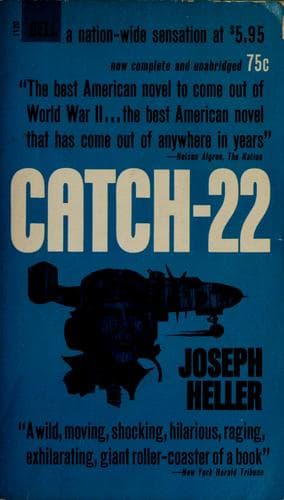
Book details and cover from Google Books.
Ready to read Catch-22?
Get your copy on Amazon, or listen to it on Audible. We earn a commission if you buy through these links.