
We earn a commission if you buy through these links. Learn more
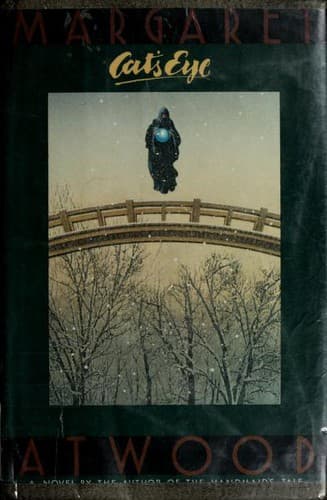
Cat's Eye
A quietly devastating look at how childhood cruelty and friendship shape an adult artist, told through memory, painting, and a return to the city of her youth.
What It's About
Cat's Eye follows Elaine Risley, a painter in middle age, as a retrospective of her work brings her back to Toronto, the city where she grew up. Rather than tell her story in a straight line, Atwood moves between the present-day visit and Elaine's memories of childhood, adolescence, and her years as a working artist. Each period pulls the next into view, so the past feels less like a backstory than a second place Elaine keeps returning to.
The emotional center is a girlhood friendship with Cordelia, a confident and often cruel girl whose approval Elaine both craves and fears. The novel is patient with how children hurt one another, how small groups form and turn on their members, and how adults who should have noticed often looked away. Atwood's prose is precise and observant, with sharp images of the Toronto ravines and the everyday rituals of school life.
Reading it feels like sitting with someone slowly working out what happened to her. The pace is unhurried, the narration sometimes doubles back on itself, and the book asks you to take small betrayals as seriously as large ones. It rewards close attention more than speed, and it lingers after you finish.
Read this if you…
- enjoy novels that move back and forth between past and present
- are interested in artists and how they make sense of their own lives
- can settle into slow, reflective prose with a dark undertow
Skip it if you…
- want a plot-driven story with a clear forward momentum
- find stories about cruelty between girls too painful to revisit right now
Key Ideas
- 1
Memory as an unreliable record
Elaine remembers her past through the lens of her present anxieties, so the book constantly reminds you that recollection is a kind of reconstruction. Atwood uses this instability on purpose, asking readers to notice what Elaine skips, reframes, or cannot yet look at directly.
- 2
Childhood cruelty taken seriously
The novel treats the bullying of young girls as formative rather than trivial. It shows how social pressure, the need to belong, and the absence of protective adults can shape a person's sense of self for decades, without ever turning the children into simple villains or victims.
- 3
Art as a way of seeing the past
Painting gives Elaine a language for revisiting what she lived through. Her work becomes a method of looking closely, sorting layers, and making sense of experience, which makes the novel as much about perception and craft as about friendship.
- 4
Friendship and the hierarchy of girls
Elaine's relationships with her peers are organized around status, loyalty, and fear of exclusion. Atwood shows how those dynamics persist into adulthood, influencing who we become and how we measure ourselves against the people we once wanted to impress.
Limitations
Some readers find the book slow, especially in its middle sections, where memories accumulate without much forward pull. The narrative's loops and digressions are deliberate but can feel repetitive, and a few plot threads are left more suggestive than resolved. Elaine can be a hard narrator to warm to, since she is often guarded and self-critical. Parts of the setting and social attitudes also reflect the late twentieth century, so the book can feel more firmly rooted in its era than some newer novels.
Questions Readers Ask
- Who is Cat's Eye best suited for?
- It suits readers who enjoy literary fiction with a reflective, layered structure and are comfortable with an unhurried pace. If you like novels that explore memory, art, and the lasting effects of childhood, you will likely find it rewarding. Readers who want fast plot events may find it frustrating.
- How does Cat's Eye compare to The Handmaid's Tale?
- The two books are very different in tone and structure. The Handmaid's Tale is a tightly focused dystopian story with urgent momentum, while Cat's Eye is a quieter, more personal novel built around memory and friendship. If you loved Atwood's sharp prose but want something less plot-driven, this is a good next step.
- Published
- 1988
- ISBN
- 9788306024272
- Difficulty
- intermediate
- Category
- Fiction
Book details and cover from Google Books.
Ready to read Cat's Eye?
Get your copy on Amazon, or listen to it on Audible. We earn a commission if you buy through these links.