
We earn a commission if you buy through these links. Learn more
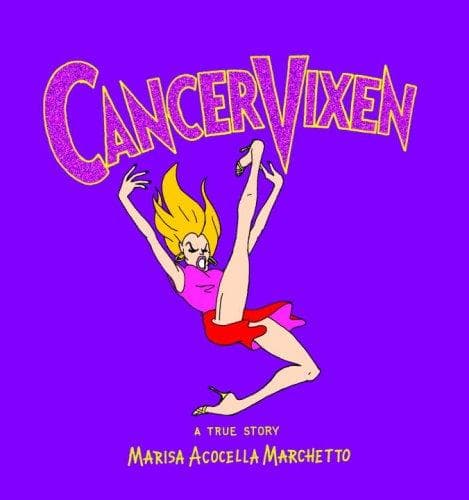
Cancer Vixen
Guide by the Books of the Day editors · Updated · How we write our guides
A funny, unsentimental graphic memoir of breast cancer treatment in Manhattan, drawn by a fashion illustrator who refuses to let illness drain the color out of her life.
What Creators Say About Cancer Vixen
2 creators reviewed Cancer Vixen on YouTube between 2008 and 2022, with 500 views between them. Their opinions are their own; we picked these reviews, we didn't write them.
What It's About
Cancer Vixen is Marisa Acocella Marchetto's account of being diagnosed with breast cancer in her early forties, told as a graphic memoir. She was a working illustrator in New York, and the book keeps that identity front and center: the drawings are bright, detailed, and full of clothes, city streets, and the small indignities of hospital life. The story follows her through diagnosis, surgery, and chemotherapy, with the practical logistics of treatment shown alongside the toll on her work, friendships, and romantic life.
The tone is the book's main asset. Marchetto is funny, often sharply so, and she is willing to be vain, angry, and absurd about herself. Her panels carry a cartoonist's exaggerated expressions and quick asides, which lets heavy material land without wallowing. Some pages step back to explain treatment in plain terms, delivered with the same wit.
Reading it feels closer to sitting across from a friend who talks fast than to reading a conventional memoir. It is brisk and easy to get through, but it lingers. Readers expecting a clinical guide or a tidy inspirational arc may find it more scattered than they want, and the humor works as a deliberate filter rather than a full portrait of fear.
Read this if you…
- want a funny, frank illness memoir rather than a sentimental one
- are curious about how comics can carry personal nonfiction
- enjoy New York settings and a fashion-world sensibility
Skip it if you…
- want detailed medical guidance or a clinical account of treatment
- prefer dense, reflective prose over visual storytelling
Key Ideas
- 1
Humor as a way of staying present
Marchetto uses jokes, exaggeration, and self-mockery to keep herself engaged with a situation that could easily have swallowed her. The humor is not a disguise for pain but a method of getting through each day. Readers can see how wit becomes a coping tool, and how it sometimes cuts against the moments that call for quiet. The book treats laughter as a practical choice rather than a message of cheerfulness.
- 2
Appearance and identity under pressure
For someone whose work centers on fashion and style, losing hair and changing how her body looks touches something deeper than vanity. The book examines how a person's professional self and public image get tangled up with illness. Marchetto is candid about feeling foolish for caring, and about caring anyway. This thread gives the memoir a specific angle that a general cancer story would not have.
- 3
Friendship, dating, and who shows up
Illness reshuffles relationships, and the book pays close attention to who stays, who drifts, and how awkward people can be when they do not know what to say. Romance and dating also run through the story, adding a layer of everyday life that keeps the focus off the disease alone. The portrait of her social world is a large part of what makes the book feel lived in.
- 4
Comics as a record of lived experience
Drawing her own story gives Marchetto control over tone, pacing, and emphasis, and the images often say what text could not. Panels can compress a waiting room, a bad day, or a look between two people into a single frame. For readers curious about what graphic memoir can do with nonfiction, the book is a useful example of visual storytelling applied to a painful subject.
Limitations
The book reflects one woman's experience in a particular social and professional setting, and it does not try to speak for everyone with breast cancer. Some readers find the humor deflecting and wish it went further into fear or grief. The cartoon style is busy and cluttered, which not everyone enjoys. Published in 2006, it also predates many later changes in treatment, so its medical details are dated and should not be used as current guidance.
Questions Readers Ask
- Is Cancer Vixen useful for someone going through cancer treatment?
- Many readers find it comforting because it is honest, funny, and unafraid to show the unglamorous side of treatment. It is not a medical guide, though, and its treatment details are from the mid-2000s. Use it for company and perspective, and rely on your care team for current information about your own situation.
- Do you need to enjoy comics to read it?
- No, though it helps to be willing to read images and text together. The panels are dense in places, but the story is linear and easy to follow. Readers who have never picked up a graphic memoir often find it a good entry point because the narration is so direct.
- What should I read if I liked Cancer Vixen?
- Readers who enjoy frank graphic memoirs about family or illness often move on to Alison Bechdel's Fun Home, which shares the form and a similarly literate, self-examining voice. For a more clinical account of living with cancer, a physician-written or journalistic memoir would offer a different kind of perspective.
- Published
- 2006
- ISBN
- 9780676978247
- Difficulty
- beginner
- Category
- Biographies
Book details and cover from Google Books.
Ready to read Cancer Vixen?
Get your copy on Amazon, or listen to it on Audible. We earn a commission if you buy through these links.