
We earn a commission if you buy through these links. Learn more
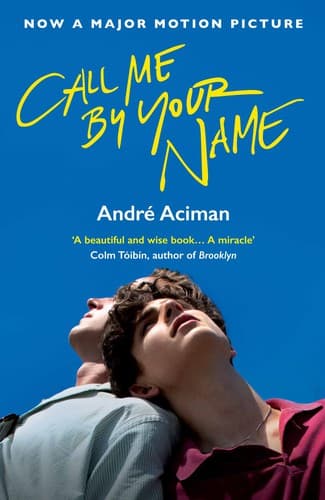
Call Me by Your Name
by André Aciman
On screen: Call Me by Your Name (film, 2017)
A lush, intensely interior coming-of-age love story set over one Italian summer, worth reading for its attention to desire, memory, and the slow ache of first love.
What It's About
Call Me by Your Name is a coming-of-age love story set in the summer of 1983 at a family villa in northern Italy. Elio, a precocious seventeen-year-old who reads widely and plays piano, spends his days in the heat and leisure of the countryside. Each summer his parents host a graduate-age American scholar to help with his father's academic work. This year the guest is Oliver, a confident, somewhat aloof young man, and the novel traces the slow, torturous build of Elio's attraction to him.
The book is narrated by Elio looking back from later life, and that adult voice gives the summer a melancholy, reflective tone. The prose is long, winding, and sensual, full of close attention to small gestures, light, food, and music, and of intellectual digressions about art and language. Much of the drama happens inside Elio's head, so the book is less about what happens than about the texture of wanting.
Reading it is an immersive, unhurried experience. It asks for patience with repetition and with long stretches of brooding, and its emotional force builds gradually. Readers who let its rhythms take hold will find it lingering long after the last page, though those who need brisk plotting may find it slow.
Read this if you…
- love slow, interior novels where mood and atmosphere matter as much as plot
- want a coming-of-age story about first desire that does not look away from its intensity
- enjoy long, lyrical sentences and do not mind lingering in a single feeling for pages
Skip it if you…
- need a fast-moving plot or a clear, tidy resolution
- are uncomfortable with frank sexual content, which is a significant part of the book
Key Ideas
- 1
Desire studied with scholarly seriousness
Elio treats his feelings the way a student of art or philosophy would, dissecting every glance, pause, and remark. This turns longing into an intellectual project as well as a physical one, and it shapes the reader's sense of how seriously to take the narrator's obsession.
- 2
Intellect and sensuality held together
The household prizes classical learning, languages, music, and art, and the novel uses these pursuits to think about the body. Books, statues, and melodies become ways of talking about physical attraction, so the sensual and the cerebral keep bleeding into one another.
- 3
Summer as a bounded, fragile world
The villa, its heat, its idle afternoons, and its ritualized routines create a sense that time is both endless and about to run out. Much of the book's tension comes from the knowledge that this particular season cannot last.
- 4
Memory filtering the past
Because Elio narrates from years later, the events are colored by hindsight and by a wistful adult awareness of what they meant. The gap between the young narrator's feelings and the older one's reflections gives the book its distinctive emotional depth.
- 5
A privileged, cultivated bubble
The family's ease, travel, and intellectual leisure shape the story's atmosphere and its sense of freedom. Readers should notice how much the setting depends on this comfortable world, which some will find enchanting and others find remote.
Limitations
Many readers find the book slow, with long passages of rumination that repeat the same emotional beats. Oliver stays partly opaque because we see him only through Elio's obsessive eyes, which can frustrate readers who want a fuller sense of the other character. The privileged European setting and its leisure can feel distant or idealized. The sexual content and the protagonist's age also make some readers uneasy, and the 1983 setting carries the assumptions of its era, which some readers will notice more than others.
Questions Readers Ask
- Is Call Me by Your Name a typical romance novel?
- Not really. It is a love story, but it reads more like literary fiction about adolescence, memory, and longing. The emotional payoff comes from interior reflection rather than the genre conventions readers may expect from romance, so it suits readers who enjoy introspective writing.
- How does the book compare to the 2017 film?
- The film captures the summer's mood through landscape, music, and performance. The novel spends far more time inside Elio's head, explaining through thought what the film shows through looks and silences. Readers who loved the movie often find the book richer, though slower.
- Is there a sequel?
- Yes. Find Me, published in 2019, follows these characters years later. Many readers who finish the first novel want to continue with it, but the sequel is best approached after you have absorbed the original's tone and emotional world.
- Published
- 2007
- ISBN
- 9781786499998
- Difficulty
- intermediate
- Category
- Romance
Book details and cover from Google Books.
Ready to read Call Me by Your Name?
Get your copy on Amazon, or listen to it on Audible. We earn a commission if you buy through these links.