
We earn a commission if you buy through these links. Learn more
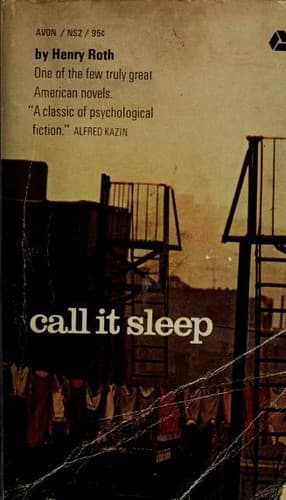
Call It Sleep
by Henry Roth
Guide by the Books of the Day editors · Updated · How we write our guides
Henry Roth's 1934 novel is a rare, demanding portrait of childhood fear and wonder in immigrant New York, written with a sensory intensity few American novels match.
What Creators Say About Call It Sleep
2 creators reviewed Call It Sleep on YouTube between 2017 and 2023, with 1.9K views between them. Their opinions are their own; we picked these reviews, we didn't write them.
What It's About
Call It Sleep follows David Schearl, a young Jewish boy whose family has recently arrived in New York and settled among the crowded tenements of the Lower East Side. He tries to make sense of a neighborhood full of languages, quarrels, and sudden violence, and of the tensions at home, where his parents' hopes and frustrations press in on him. Roth tells the story almost entirely through David's perception, so the world arrives as sounds, smells, textures, and half-understood words, with Yiddish, English, and broken speech all tangled together.
The prose is the main event. Roth writes in dense, lyrical, sometimes fractured sentences that slide between close observation and the boy's inner life, and he gives ordinary street noise and household scenes the weight of revelation. Readers used to plot-driven fiction may find the early sections slow. The pleasure grows as patterns emerge and recurring images, especially light, electricity, and the sounds of the city, begin to carry meaning.
Reading it feels less like following a story than like being inside a child's attention for several hundred pages, with its fear, confusion, and flashes of wonder. It is a novel about faith, language, family pressure, and the struggle to belong, and it rewards slow reading and a second visit.
Read this if you…
- are willing to slow down for dense, sensory, literary prose
- are interested in immigrant life in early twentieth-century New York
- want an American novel that works in the same territory as modernist writers like Joyce
Skip it if you…
- want a fast-moving plot or clear, linear storytelling
- find heavy dialect and scenes of family violence hard to sit with
Key Ideas
- 1
A child's perception as the whole world
Roth keeps the reader close to David's senses and misunderstandings, so adult events arrive without explanation. Adults fight, streets roar, and objects glow with meaning the boy cannot yet name. The result is a book where confusion itself becomes the subject, and where the reader must piece together what is happening much as David does.
- 2
Language as a border between worlds
The family and neighborhood move between Yiddish, English, and fragments of other tongues. Words that should connect people often divide them, and David's growing command of English becomes tied to his sense of who he is and where he belongs. Roth makes the sound of speech a central part of the novel's texture.
- 3
Fear and wonder inside a tenement family
Home is a place of tension, with a father whose temper and disappointments weigh on the household and a mother working to hold things together. David feels guilt, dread, and a pull toward the city outside. The novel treats these pressures with unsentimental honesty and does not offer an easy moral about family or class.
- 4
The sacred hidden in everyday things
Electricity, wires, and light recur throughout the book and take on a near-mystical charge for David. Roth uses these images to suggest that ordinary, dangerous things can feel holy to a child searching for power and meaning. Readers who notice the pattern will find the symbolism deepens as the story goes on.
Limitations
The prose is demanding and can feel relentless, especially for readers who expect scenes to resolve or characters to explain themselves. Yiddish and dialect passages are not always glossed, which adds to the difficulty. Some adult characters, particularly the women, are seen mainly through David's eyes and can feel thinly drawn. Published in 1934 and largely overlooked at the time, the book also reflects the social world of its period, so some of its attitudes and details feel historical rather than current.
Questions Readers Ask
- Is Call It Sleep still worth reading today?
- Yes, especially if you care about experimental prose or the immigrant experience. The book was largely overlooked when it first appeared and was rediscovered decades later, and many readers now see it as a major American novel. Its concerns with childhood, language, and belonging have not faded, though its historical setting may need some context.
- How does it compare to Joyce's A Portrait of the Artist as a Young Man?
- Both use a young protagonist's consciousness and treat childhood perception seriously. Roth's book is more rooted in the streets and tenements of a specific immigrant neighborhood, and its language mixes several tongues. Readers who enjoyed Joyce's close, sensory style will likely find Roth rewarding, though the emotional register here is rawer.
- Is this only a novel about Jewish immigrant life?
- It is rooted in Jewish immigrant life in New York, and that setting shapes its language and religious imagery. But its central concerns, including fear, belonging, and the inner life of a child, are universal. Readers without a background in that community can still follow it, though a little historical context helps.
- Published
- 1934
- ISBN
- 9780380007554
- Difficulty
- advanced
- Category
- Fiction
Book details and cover from Google Books.
Ready to read Call It Sleep?
Get your copy on Amazon, or listen to it on Audible. We earn a commission if you buy through these links.