
We earn a commission if you buy through these links. Learn more
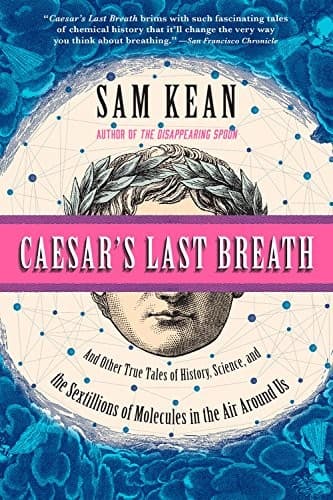
Caesar's Last Breath
by Sam Kean
Guide by the Books of the Day editors · Updated · How we write our guides
Sam Kean turns the air around us into a story of chemistry, war, and discovery, showing how the gases we breathe shaped modern life and history.
What Creators Say About Caesar's Last Breath
1 creator reviewed Caesar's Last Breath on YouTube between 2025 and 2026, with 11 views between them. Their opinions are their own; we picked these reviews, we didn't write them.
What It's About
Caesar's Last Breath is popular science history built around a simple, striking idea: the atmosphere is shared, so the air you breathe has been breathed, exhaled, and recycled by countless people and creatures before you. Kean uses that premise as a loose thread and follows the story of the gases that make up the atmosphere, from the eighteenth-century chemists who first isolated them to the twentieth-century industrialists who learned to manipulate them.
The book moves through a series of vivid characters and episodes rather than a tidy theory. You'll meet scientists working out what air is made of, the people who turned those discoveries into fertilizer and weapons, and the long, uneven path toward understanding how the atmosphere can change. Kean writes in a conversational voice, packing in anecdotes, asides, and small surprises, so the pages move quickly even when the chemistry gets dense.
Reading it feels like being led through a museum by a friend who has read far too much and wants you to notice everything. Some stretches are funnier and more personal than others, and the pacing is looser than a textbook's. The payoff is a new way of seeing ordinary air as something with a history.
Read this if you…
- Enjoy narrative science history full of colorful characters and digressions
- Want to understand chemistry through its human stories rather than equations
- Like learning surprising connections between everyday things and big historical events
Skip it if you…
- Want a rigorous, source-by-source history or a dense technical treatment of atmospheric science
- Prefer tightly structured books with a single argument and a clear chapter-by-chapter logic
Key Ideas
- 1
The atmosphere is a shared, recycled resource
Kean's central conceit is that air mixes so thoroughly that each breath likely contains molecules that once passed through people from the past. This makes history feel physical: the planet's air carries a record of everyone who has lived. The idea gives the book its emotional hook and frames the more technical material that follows.
- 2
Discovering what air is made of
Much of the book traces how scientists slowly learned that air is not a single substance but a mixture of gases with distinct roles. Early experiments were messy, rivalrous, and often wrong, and Kean shows how those mistakes shaped the modern picture of chemistry. The story is as much about people and personalities as about the gases themselves.
- 3
Chemistry as a double-edged tool
Kean repeatedly shows the same chemical knowledge being used to feed populations and to kill them. Techniques for fixing nitrogen into fertilizer and for producing gases for warfare grew from overlapping research. The book does not let readers treat scientific progress as simply good, and it asks uncomfortable questions about who benefits and who pays.
- 4
The atmosphere as a changing system
Later sections look at how human activity alters the chemistry of the air, and how scientists came to understand these changes. Kean explains the logic of atmospheric change in accessible terms, so readers get a sense of why the subject matters now without needing a background in climate science.
Limitations
Kean's style is the book's strength and its weakness. The tangents and anecdotes can feel scattered, and some readers will find the transitions between topics abrupt. Specialists may judge certain historical and scientific simplifications as loose, since the book aims for general readers rather than experts. Coverage is selective: it is a guided tour of the atmosphere's story, not an exhaustive account of any single topic. Its science also reflects the state of knowledge at publication, so readers wanting the latest findings on atmospheric change will need to look further.
Questions Readers Ask
- Is Caesar's Last Breath good for readers with no chemistry background?
- Yes. Kean explains the basic chemistry in plain language and leans on stories about the people involved. You will need little prior knowledge, though some sections on molecules and reactions require patience. Most general readers who enjoy popular science should find it approachable.
- How does it compare to other popular science books about chemistry?
- It is closer in spirit to Kean's other books than to a conventional textbook. If you enjoy his storytelling style, the book will feel familiar. If you want a more focused treatment of a single element or process, a dedicated book on that topic will go deeper than this one.
- Published
- 2017
- ISBN
- 9781784162931
- Difficulty
- beginner
- Category
- Tech
Book details and cover from Google Books.
Ready to read Caesar's Last Breath?
Get your copy on Amazon, or listen to it on Audible. We earn a commission if you buy through these links.