
We earn a commission if you buy through these links. Learn more
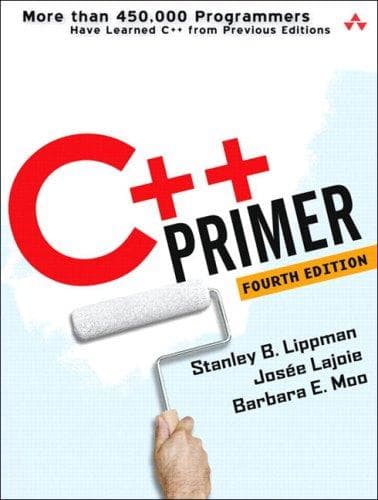
C++ Primer
The most thorough structured route into C++ for readers starting from scratch, built around exercises that turn reading into working code.
What It's About
C++ Primer is a long, systematic textbook for learning C++ from the ground up. Stanley B. Lippman wrote it with Josée Lajoie and Barbara E. Moo, and its most widely used edition centers on the C++11 standard. The book moves in a deliberate order: basic syntax and types first, then control flow, functions, classes, templates, and the standard library, with each stage building on the last.
The style is patient and example-heavy. Concepts are introduced with short, complete programs, and key points are reinforced through summaries and warnings about common mistakes. Exercises appear throughout, and working through them is where most of the learning happens. The authors spend real time on why the language behaves as it does, not just on what to type, which makes it feel more like a course than a manual.
Reading it is a commitment rather than a quick read. It runs to several hundred pages of dense material, and the pace is steady rather than fast. Expect to read a section, try the code, and return to it later. It rewards a reader who wants a solid foundation and is willing to spend a few hours a week with a compiler open.
Read this if you…
- want a thorough, structured path into C++ from little or no prior experience
- learn best by doing exercises and prefer a textbook pace to a quick overview
- are coming from another language and want to understand C++ design, not just its syntax
Skip it if you…
- already write C++ professionally and mainly need a quick reference or a book on advanced design
- want a short introduction you can finish in a weekend
Key Ideas
- 1
Learn the language in deliberate layers
The book treats C++ as a stack of ideas, each resting on the previous one. Early chapters stay with values, types, and simple statements so that later material on classes and templates feels like a natural extension rather than a jump. Readers who skip ahead tend to find the later chapters harder than they need to be.
- 2
Types, memory, and what really happens
A large share of the learning goes into how C++ stores and passes data. Pointers, references, const correctness, and object lifetimes are explained carefully, because they are where most beginners get confused and where most real bugs come from. The emphasis is on building an accurate mental model of the machine underneath the syntax.
- 3
Classes as the core of abstraction
Classes are presented as the main tool for organizing code around meaningful types. The book walks through constructors, member functions, access control, and how objects are copied and destroyed. Inheritance and polymorphism come later, and they are introduced with an eye toward when they are actually useful rather than as a showcase of features.
- 4
The standard library as everyday toolkit
Containers, iterators, and algorithms are taught as a single connected system rather than a list of classes to memorize. The reader learns to choose a container based on how the data will be used and to express loops as calls to generic algorithms. This section is often the point where the language starts to feel productive.
- 5
Modern features introduced in C++11
Features such as automatic type deduction, range-based loops, lambdas, and move semantics are woven into the material rather than tacked on at the end. For readers who learned older C++ habits elsewhere, this is a useful way to see how idiomatic code shifted, though it also means some newer standards are covered less thoroughly.
Limitations
The book's most common edition is built around C++11, so features from later standards such as C++14, C++17, and C++20 receive limited or no coverage. Check which edition you are buying and whether it reflects the standard your work uses. Its length and steady pace can feel slow to experienced programmers, and it is not designed as a reference you consult for a single function signature. It also says little about build systems, tooling, or large-scale software design, which readers will need to learn elsewhere.
Questions Readers Ask
- Is C++ Primer still relevant for learning C++?
- The core of the language, including types, classes, and the standard library, has changed far less than its newer features. The book remains a sound foundation. For current practice, pair it with material on C++17 or later, or use a newer edition if one matches the standard your projects target.
- How does C++ Primer compare to Effective C++?
- They serve different readers. C++ Primer teaches the language from the beginning with extensive exercises. Effective C++ by Scott Meyers is a shorter collection of guidelines for programmers who already know the language and want to write cleaner, safer code. Many people read Primer first and Meyers afterward.
- Do I need programming experience before starting?
- Prior experience in any language helps, because the book does not spend long on general programming concepts. Complete beginners can still succeed if they are patient and work through the exercises, but expect the first several chapters to take considerable time.
- Published
- 1989
- ISBN
- 9780201721485
- Difficulty
- beginner
- Category
- Tech
Book details and cover from Google Books.
Ready to read C++ Primer?
Get your copy on Amazon, or listen to it on Audible. We earn a commission if you buy through these links.