
We earn a commission if you buy through these links. Learn more
Buddha's brain
by Rick Hanson
A practical, accessible guide to how the brain's wiring shapes mood and habits, paired with exercises for building calmer, more compassionate patterns.
What It's About
Buddha's Brain is a popular science book that tries to connect what neuroscience knows about the brain with long-standing contemplative ideas about contentment, compassion, and clear thinking. Hanson, a psychologist, writes with Richard Mendius, a neurologist. They start with how neurons and the evolved brain work, then show how everyday mental states can gradually reshape neural circuitry over time.
The style is warm, direct, and practical. Rather than reading like a textbook, it often feels closer to a guided workbook, with brain science offered as the reason behind suggested habits, reflections, and small exercises you can try. The authors repeatedly frame the goal as learning to work with your brain's tendencies instead of being ruled by them.
The experience is encouraging and occasionally repetitive. Some passages read like a pep talk, and the book spends more time applying its ideas than testing each claim against the research. Readers who want step-by-step mental training will find plenty to use. Readers who want a rigorous survey of neuroscience will need to look further.
Read this if you…
- are curious how brain science can inform everyday habits like calm, gratitude, and self-compassion
- want a hands-on, exercise-friendly introduction to mindfulness and emotional regulation
- are new to neuroscience and want an approachable entry point rather than a dense technical text
Skip it if you…
- want a rigorous, citation-heavy review of current neuroscience or meditation research
- find self-help framing and frequent encouragement off-putting
Key Ideas
- 1
The brain is built to notice threats first
The authors describe a negativity bias: brains evolved to register danger and loss more quickly than safety and reward. That helps survival but tends to make ordinary worries sticky and good news easy to overlook. The book uses this idea to explain why people often feel stressed even when their circumstances are fine, and why deliberately noticing what is going well can counterbalance it.
- 2
Repeated experience leaves lasting neural traces
Drawing on the old principle that neurons that fire together wire together, Hanson argues that brief positive experiences, if noticed and held in attention, can be strengthened through repetition. This leads to a practice of savoring pleasant moments and letting them sink in, rather than letting them pass unregistered. The idea is intuitive, though the book's strongest claims are more a framework than a proven method.
- 3
Mental training as deliberate rewiring
Meditation and focused attention are presented as tools for changing habitual reactions, such as irritability or anxiety, over time. The book treats these practices as a kind of skill-building that reshapes how the brain responds. It is persuasive as a way to think about practice, but readers should understand that the research on specific neural changes was still developing when it was written.
- 4
Connection and compassion as core brain needs
The authors give substantial attention to the brain's social wiring, arguing that feeling safe, cared for, and connected affects stress regulation and wellbeing. This section links relationships to emotional health in a way that is easy to apply in daily life. It is less about a single mechanism and more about a broad case that people do better when they feel bonded to others.
Limitations
The science is simplified for a general audience, and some claims about meditation and neural change go further than the evidence available when the book was written. The tone can feel repetitive or sermonic to readers who prefer a neutral, analytical voice. It also blends secular neuroscience with Buddhist-inspired ideas, which some readers will find illuminating and others will find muddled. Because the field has moved on since publication, readers should treat specific findings as starting points rather than settled conclusions.
Questions Readers Ask
- Do I need a background in neuroscience to read Buddha's Brain?
- No. The book is written for general readers and explains basic brain structures and processes as it goes. Some passages go into more detail than others, but you do not need prior training. Having some curiosity about how the mind works is more useful than any technical background.
- How does Buddha's Brain compare to Hanson's later book Hardwiring Happiness?
- Hardwiring Happiness is shorter, more focused on a single practical method, and more self-help in format. Buddha's Brain covers a wider range of brain science and contemplative ideas, so it is denser and more explanatory. Readers who want a quick, action-oriented guide may prefer the later book; those who want the underlying reasoning will likely prefer this one.
- Is Buddha's Brain still worth reading today?
- Yes, especially for its practical framing of attention, habit, and emotional tendencies. Some of the specific neuroscience has been refined since publication, so it is best read as an accessible introduction rather than a source of up-to-date findings. Pairing it with a current review of the research will give you a more accurate picture.
- Published
- 2009
- ISBN
- 9780369323675
- Difficulty
- intermediate
- Category
- Psychology
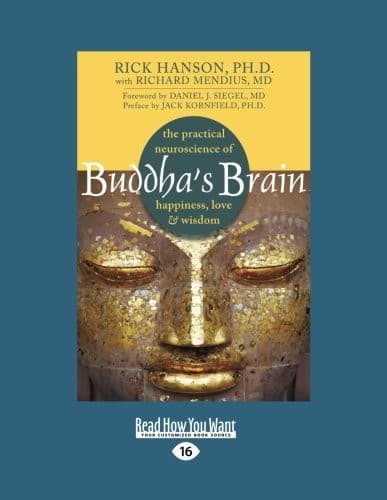
Book details and cover from Google Books.
Ready to read Buddha's brain?
Get your copy on Amazon, or listen to it on Audible. We earn a commission if you buy through these links.