
We earn a commission if you buy through these links. Learn more
Bud, Not Buddy
by Christopher Paul Curtis, Reginald André Jackson
Guide by the Books of the Day editors · Updated · How we write our guides
A warm, funny, and hard-edged Depression-era novel narrated by a ten-year-old who sets out alone to find the father he has only a flyer for.
What Creators Say About Bud, Not Buddy
2 creators reviewed Bud, Not Buddy on YouTube between 2010 and 2013, with 30.1K views between them. Their opinions are their own; we picked these reviews, we didn't write them.
What It's About
Bud, Not Buddy is a middle-grade novel by Christopher Paul Curtis, first published in 1999 and set in Flint, Michigan, in 1936, during the Great Depression. Ten-year-old Bud Caldwell has been passed from one foster home to another since his mother died, and he has little to his name beyond a suitcase, a few old handbills, and a list of rules she left him. When he runs from a foster home that treats him badly, he sets out to find the man he believes is his father, a jazz musician named Herman E. Calloway.
Curtis tells the story in Bud's first-person voice, and that voice does most of the work. Bud is funny, stubborn, and wary, and he covers his fear with jokes, lists, and rules of his own. The narration moves between the practical problems of a kid alone in a poor town and quieter moments about what family means. Humor and grief sit side by side without either cancelling the other.
Reading it feels fast and warm, with short chapters and plenty of dialogue, but the period detail is real: work lines, makeshift camps, and the ordinary cruelty of an economy that treats children and drifters as expendable. It is written for young readers, yet many adults read it in one sitting. Expect a book that is light on the page and heavier in the chest.
Read this if you…
- want a short, emotionally direct novel with a memorable narrator
- are interested in American history told through an ordinary kid's experience
- enjoy books where humor and sadness are mixed in the same paragraph
Skip it if you…
- want a fast-paced adventure with a lot of plot twists
- prefer adult historical fiction with dense, layered prose
Key Ideas
- 1
Rules as a way to hold on
Bud repeats the rules his mother wrote down, and they work as armor. When adults are unpredictable and the world offers no safety, a set of simple instructions gives him a sense of order and self-respect. Curtis shows how a child builds dignity out of small habits, and how those habits can be both a comfort and a limit on what Bud is willing to trust.
- 2
Found family and what belonging means
Bud's search for a father is really a search for a place where he is wanted. Along the way he meets people who take him in without any obligation, and the book asks whether family is defined by blood, by paperwork, or by who shows up. The answer it gives is gentle but not sentimental, and it lands because Bud has earned his doubts.
- 3
The Depression seen from the ground
The book shows hard times through a kid's eyes rather than through statistics. Hunger, odd jobs, rough camps, and the constant threat of being picked up by the wrong authority are all present, and they shape Bud's choices. Readers get a concrete sense of how economic collapse fell hardest on people with no one to vouch for them.
- 4
Humor as a survival tool
Bud's jokes and exaggerations are not decoration. They help him keep his fear at a distance and let him talk to adults on his own terms. Curtis uses comedy to make the hardship readable for young people without pretending it is not serious, and the tension between the two effects is what gives the novel its character.
Limitations
Some readers find the story episodic, with the search for Bud's father moving through a string of encounters rather than building steadily to one plot. The humor can feel repetitive to readers who expect more restraint, and the emotional resolution is more hopeful than some critics think the period warrants. The novel also presents 1930s Flint through a single child's eyes, so it does not attempt a broad survey of the era's labor politics or racial history. Note that this catalogue entry lists a co-author and a Tech category; the book as I know it is a standalone historical novel by Curtis.
Questions Readers Ask
- Who is Bud, Not Buddy best for?
- It suits confident readers aged around ten and up, and it works well for adults who want a story with real feeling and clear, plain prose. It is a good shared read for families and classrooms because it raises questions about poverty, belonging, and loyalty without lecturing. Readers who want heavy stylistic experiment or long, complicated plots may find it too simple.
- How does it compare to other Newbery-winning novels for children?
- It is closer in tone to warm, character-driven books than to fantasy or adventure titles. Compared with Kate DiCamillo's Because of Winn-Dixie, it has a similarly direct, funny narrator, but Curtis's story is grounded more firmly in economic hardship and historical setting. If you liked Bud's voice, the novel's own sequel-style follow-ups and other Depression-era children's books are natural next steps.
- Published
- 1994
- ISBN
- 9780606277181
- Difficulty
- beginner
- Category
- Tech
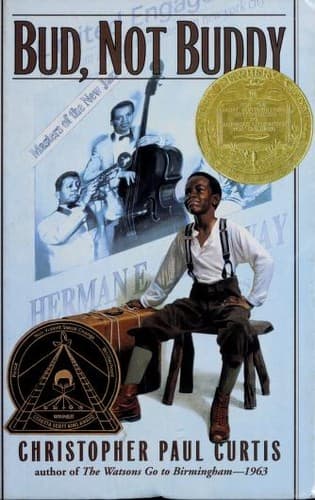
Book details and cover from Google Books.
Ready to read Bud, Not Buddy?
Get your copy on Amazon, or listen to it on Audible. We earn a commission if you buy through these links.