
We earn a commission if you buy through these links. Learn more
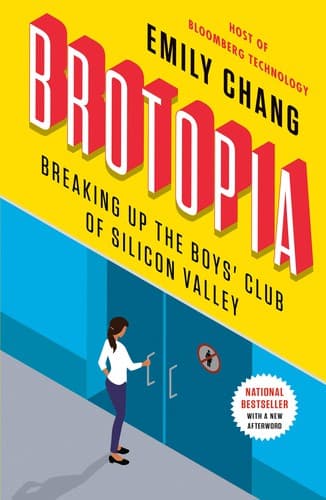
Brotopia
by Emily Chang
Guide by the Books of the Day editors · Updated · How we write our guides
Emily Chang's reported look at how Silicon Valley's social culture decides who gets funded, hired, and heard makes it a useful, human-scale entry point into gender and tech.
What Creators Say About Brotopia
2 creators reviewed Brotopia on YouTube between 2019 and 2020, with 6.9K views between them. Their opinions are their own; we picked these reviews, we didn't write them.
What It's About
Brotopia is a work of narrative journalism by Emily Chang, a technology reporter who has spent years covering Silicon Valley. Its central argument is that the valley's exclusion of women is not only the result of individual prejudice but of a culture built around social habits, from late-night parties to tight networks of male investors and founders, that quietly shape who gets money, who gets hired, and whose ideas are taken seriously. Chang moves between profiles of founders, employees, and investors and the wider history of the industry to show how these patterns took shape.
The book is organized around people and episodes rather than an academic thesis. It draws on interviews and firsthand accounts of workplace conflict, including legal disputes and public scandals that made headlines. The tone is direct and reported, closer to long-form magazine investigation than to scholarly analysis. Chang is more interested in how a single meeting, party, or hiring decision can carry real consequences than in building abstract theory.
Reading it feels like being walked through a series of uncomfortable rooms. It is pointed in places but usually stays close to what people said and did. The experience resembles a long feature series more than a practical manual, so readers hoping for a step-by-step plan to fix tech hiring will only find partial answers. It works best as a document of a particular moment and a set of arguments that still shape current debates.
Read this if you…
- want a reported, people-centered look at gender in tech
- are curious how investment culture shapes which companies get built
- work in or around startups and want to recognize these patterns
Skip it if you…
- want a rigorous academic study with data and citations
- are looking for a practical playbook for hiring or management
Key Ideas
- 1
Culture shapes outcomes, not just individual bias
Chang argues that the problem is embedded in everyday norms, such as who socializes after hours, who is invited into the inner circle, and what counts as a good fit. These habits can exclude women even when no one intends to exclude anyone, which makes the issue harder to address with simple rules.
- 2
Venture money moves through personal networks
Funding decisions often depend on trust, referrals, and familiarity between investors and founders. The book shows how that closed system can disadvantage women who lack access to the same circles, even when their pitches are strong. It is a clear explanation of why capital flows the way it does.
- 3
Women once had a larger role in computing
Chang points out that women held a significant share of programming and computing work in earlier decades, which challenges the assumption that the field was always male-coded. The point is used to show that the current imbalance reflects choices and cultural shifts rather than a fixed natural order.
- 4
The cost of reporting misconduct
The book examines what happens when women raise complaints about harassment or unfair treatment, including the professional and personal risks involved. It helps readers see why many incidents go unreported and how institutional responses can either protect people or push them out.
Limitations
Critics have noted that the book leans heavily on a small set of high-profile cases and on the experiences of relatively privileged women, which can make its picture of the industry feel narrower than its title suggests. Its proposed solutions are modest and often left at the level of awareness. Because it was published several years ago, some companies, people, and policies it describes have since changed, so it is best read alongside more recent coverage.
Questions Readers Ask
- Is Brotopia still relevant today?
- The core patterns it describes, especially the role of personal networks in venture capital and the debate over workplace culture, remain active topics. However, many specific companies and cases have moved on since publication. Reading it alongside newer reporting will give you a fuller and more current picture.
- How does Brotopia compare to Invisible Women?
- Invisible Women by Caroline Criado Perez is broader and built around data across many fields, from medicine to city planning. Brotopia is narrower, focused on Silicon Valley, and told through reporting and personal stories. Readers who want evidence-heavy analysis may prefer the former, while those interested in one industry's culture may prefer the latter.
- Do I need a background in technology to enjoy it?
- No. Chang explains the relevant business and industry terms as she goes, and the book is written for a general reader. Some familiarity with startups or tech news will help you recognize the names and episodes, but it is not required to follow the argument.
- Published
- 2018
- ISBN
- 9786052314326
- Difficulty
- beginner
- Category
- Tech
Book details and cover from Google Books.
Ready to read Brotopia?
Get your copy on Amazon, or listen to it on Audible. We earn a commission if you buy through these links.