
We earn a commission if you buy through these links. Learn more
Bridge to Terabithia
On screen: Bridge to Terabithia (film, 2007)
Guide by the Books of the Day editors · Updated · How we write our guides
A short, emotionally direct novel about friendship, imagination, and grief that trusts young readers with a hard subject and still leaves them with real hope.
What Creators Say About Bridge to Terabithia
2 creators reviewed Bridge to Terabithia on YouTube between 2011 and 2013, with 119.9K views between them. Their opinions are their own; we picked these reviews, we didn't write them.
What It's About
Bridge to Terabithia follows Jess Aarons, a boy in rural Virginia who spends much of his time running, drawing, and trying to stay out of his family's way. When Leslie Burke moves in next door, she arrives from elsewhere with different money, habits, and ways of thinking, and she treats Jess as an equal. Together they build an imaginary kingdom in the woods, reached by a rope swing over a creek, and they rule it with a seriousness that the rest of their lives rarely allow.
Paterson writes in plain, unfussy prose and keeps the narration close to Jess, so the book's pleasures come from small observed details: schoolyard cruelty, a father who is hard to reach, and the way a child's fantasy can feel more real than the classroom. The fantasy sequences are brief. Most of the novel sits in ordinary life, which is why its turn lands so hard.
Reading it is a quick experience but not a light one. The book asks you to sit with grief rather than hurry past it, and it treats its child characters as capable of understanding loss, cruelty, and kindness at once. Adults often reread it with a different eye than they had at ten.
Read this if you…
- want a short novel that takes children's emotional lives seriously
- are interested in how fantasy can help a young person face real pain
- are rereading it as an adult and want to see what the book does with grief
Skip it if you…
- need a light, purely fun read with a reassuring arc
- are looking for a fast-paced adventure with lots of plot and action
Key Ideas
- 1
Imagination as a place to be brave
Terabithia works because it gives the two children a space where they can be braver, kinder, and more capable than they feel in school or at home. The kingdom is not an escape from problems so much as a rehearsal for facing them. Paterson shows how invented worlds can carry real emotional weight and shape how a child sees their own courage.
- 2
Friendship that crosses class and background
Jess and Leslie come from families with very different incomes, expectations, and standing in their community. Their bond is tested by the pull of the people around them, from classmates to parents. The novel is honest that friendship across such gaps is valuable but never simple, and that other people's judgments can press hard on it.
- 3
Grief without easy comfort
The book gives its loss the weight it deserves and does not rush to tidy up the feelings it produces. Characters respond in different and sometimes unfair ways, and the narrative lets anger, guilt, and confusion sit on the page. This is the book's most discussed quality and the reason many readers remember it decades later.
- 4
Fathers, belief, and the adult world
Jess's relationship with his father is central, though quiet. The novel looks at how adults can be absent or unable to talk about what matters, and how a child must find other people to lean on. Church, school, and family are shown as sources of both support and pressure, without a neat moral verdict.
Limitations
The book is firmly of its time: its 1970s rural setting, its gender roles, and its portrayal of class and race reflect assumptions that many modern readers find dated. Some critics feel the fantasy and the grief are handled through a fairly narrow, middle-class lens, and that the Black and working-class characters are less fully developed than the central pair. The novel also does not explore its themes of loss in depth beyond Jess's point of view. Its emotional directness has led some schools and parents to challenge it.
Questions Readers Ask
- Is Bridge to Terabithia only for children?
- No. It is written for middle-grade readers, but its prose is simple rather than simplistic, and many adults find it more affecting than they expected. Parents often read it alongside their children, and it works well as a book for a book club or classroom discussion. Adults who read it at a young age often come back to it and notice different things about family, class, and loss.
- How does it compare to A Wrinkle in Time?
- Madeleine L'Engle's A Wrinkle in Time is a common comparison, since both use fantasy to explore hard questions. L'Engle's book is cosmic and sprawling, with wide-ranging ideas about good and evil. Paterson's is small and domestic, focused on two children, one place, and one loss. Readers who enjoyed the scale of L'Engle may find Paterson more intimate.
- Published
- 1972
- ISBN
- 9780141928845
- Difficulty
- beginner
- Category
- Children's Books
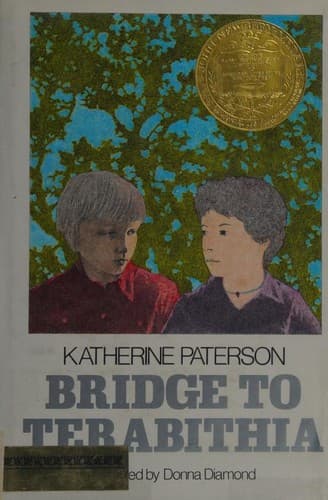
Book details and cover from Google Books.
Ready to read Bridge to Terabithia?
Get your copy on Amazon, or listen to it on Audible. We earn a commission if you buy through these links.