
We earn a commission if you buy through these links. Learn more
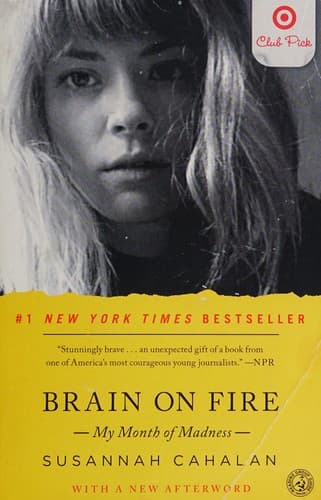
Brain on fire
Guide by the Books of the Day editors · Updated · How we write our guides
A reporter's gripping memoir of a sudden illness that doctors first mistook for a mental breakdown, told with the rigor of a detective story.
What Creators Say About Brain on fire
2 creators reviewed Brain on fire on YouTube between 2015 and 2018, with 7.5K views between them. Their opinions are their own; we picked these reviews, we didn't write them.
What It's About
Brain on Fire is a memoir by Susannah Cahalan, a New York Post reporter who, in 2009 at age 24, began to unravel over a few weeks. She went through paranoia, hallucinations, seizures, and memory loss. Doctors first suspected a psychiatric illness, and the book follows the stretch of time she spent in hospital while her condition was misread before it was identified.
Cahalan writes as a reporter as well as a patient. Because she has no memory of much of that period, she reconstructs it from medical records, video recorded during her monitoring, and interviews with family, friends, and hospital staff. The result is a medical mystery where the investigator and the subject are the same person, and the writing stays clear and direct when it explains the neurology.
The reading experience is gripping and often unsettling, especially in the passages describing what it is like to be unable to recognize your own mind. It is less a deep dive into research than a personal account with enough science to make the diagnosis intelligible. Its emotional center is her family's endurance and the larger question of how much weight we give a patient's own account of what is happening to them.
Read this if you…
- are curious about how medical diagnoses get made and why they sometimes go wrong
- want a true story with a real mystery and a clear narrative drive
- are interested in how illness changes memory, personality, and a sense of self
Skip it if you…
- want a rigorous, up-to-date survey of autoimmune brain disease or the research behind it
- prefer memoirs built around reflection and ideas rather than a series of medical events
Key Ideas
- 1
A treatable illness mistaken for mental illness
The core of the book is how easily a physical disease can look like a psychiatric one, especially when symptoms are dramatic and tests come back unclear. Cahalan shows how labels can stick to a patient and shape every decision that follows, and how a single observant clinician can change the outcome.
- 2
Memory, identity, and the gaps in a life
With memories of her illness missing, Cahalan has to ask how much of a person's identity lives in recall. The book explores what it means to rebuild your own story from other people's testimony, photographs, and records, and how unsettling it is to read about yourself as if you were a stranger.
- 3
The patient as reporter
Cahalan brings journalistic habits to her own case: checking sources, weighing documents against recollection, and being candid about what she cannot know. This gives the book a distinctive tone, somewhere between a clinical case file and a personal confession, and it makes the reader think about the limits of any single account.
- 4
Caregiving and what families endure
Much of the book's weight falls on the people around her, who had to advocate for her while she could not advocate for herself. Their frustration, fear, and persistence are portrayed without sentimentality, and they show how much a patient depends on the people who refuse to accept a wrong diagnosis.
Limitations
The book rests on one person's case at one hospital, so it shows how a rare illness unfolded for Cahalan rather than what patients generally experience. Its science is simplified for a general audience, and some readers may want more depth on the disease and its treatment. Because she reconstructs much of her hospital stay from records and other people's accounts, a few details depend on memory and testimony, which she acknowledges. The medical background also dates from the early 2010s, and research on this condition has moved on since then.
Questions Readers Ask
- Is Brain on Fire a true story?
- Yes. It is a memoir about Cahalan's own illness in 2009. Because she has no memory of much of her hospital stay, she rebuilt that period from medical records, recorded footage, and interviews, and she is open about where her account depends on other people's recollections.
- Is the book still relevant?
- Yes, especially for anyone interested in how the condition can be missed or misread. The science has advanced since the book was published, so use it for the human story and the diagnostic lessons rather than as a current medical guide.
- How does it compare to Oliver Sacks?
- Sacks wrote as a physician describing patients he observed, while Cahalan writes from inside the experience as the patient and a reporter. If you enjoy Sacks's case studies, you will likely find her book more personal and immediate, though less analytical about the wider science.
- Published
- 2012
- ISBN
- 9781451621389
- Difficulty
- beginner
- Category
- Psychology
Book details and cover from Google Books.
Ready to read Brain on fire?
Get your copy on Amazon, or listen to it on Audible. We earn a commission if you buy through these links.