
We earn a commission if you buy through these links. Learn more
Bowling Alone
Putnam starts from a small puzzle, more people bowling but fewer in leagues, and builds a sweeping, data-heavy case that American civic life thinned across several decades.
What It's About
Robert D. Putnam, a political scientist, opens with a simple observation: more Americans were bowling than ever, yet fewer were joining bowling leagues. From that gap he builds an argument that the web of clubs, unions, congregations, parent groups, and neighborly habits had been weakening for decades. He calls the resource that holds these things together social capital, and he argues it shapes whether communities function, whether schools work, and whether democratic government performs well.
The approach is mostly evidential. Putnam assembles survey results, membership records, and long-run trend lines across many indicators, from voter turnout and union membership to hosting friends at home and volunteering. The prose is careful and often wry, and the book leans on charts and tables more than anecdote, though it includes enough concrete detail to stay grounded. Reading it feels like being walked through an argument by a patient, skeptical guide who keeps checking his own claims.
The experience is part diagnosis, part call to action. The first half is the richer one, where the evidence and the list of suspected causes do most of the work. Readers hoping for a neat list of fixes may find the closing sections looser, but the book is most rewarding for anyone who wants to understand why community can feel thinner and why that matters beyond nostalgia.
Read this if you…
- want a data-driven explanation of why neighborhoods, clubs, and civic groups feel thinner than they used to
- are interested in how social ties affect schools, government, and everyday trust
- enjoy a patient argument that weighs competing explanations instead of offering one tidy villain
Skip it if you…
- want a short, lively narrative or a book built around personal stories
- are looking for a practical guide to rebuilding your own community or starting a group
Key Ideas
- 1
Social capital as a measurable resource
Putnam treats connections between people, and the norms of trust and reciprocity that come with them, as something a community owns and can lose. He argues this is a real asset with effects on how well institutions and neighborhoods function, not a soft sentiment. The idea gives the book its central vocabulary and its claim that private habits have public consequences.
- 2
A decline visible across many indicators
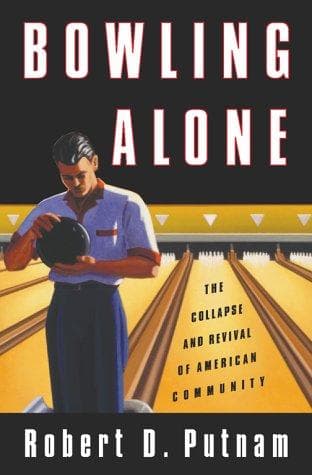
The bowling image is a hook, not the whole case. Putnam tracks falling participation in many forms of civic life across the late twentieth century, including organizations, voting, and informal socializing. The cumulative pattern, rather than any single statistic, is what makes his case feel hard to dismiss even when individual measures are debated.
- 3
Several suspects for the decline
Putnam weighs multiple explanations rather than naming one culprit. He considers the squeeze of time and money on working families, geographic mobility and suburban living, the effects of television, and generational replacement, in which an older, more civic cohort is succeeded by people with different habits. Readers will judge for themselves how convincingly he apportions blame among them.
- 4
Bonding versus bridging ties
He distinguishes between connections that tie together people who are already alike, which can build loyalty and support, and connections that cross lines of class, background, and belief. Both matter, but he worries that the civic life he is describing did more of the second kind. This distinction is one of the most useful tools the book leaves behind.
- 5
Why the trend matters beyond nostalgia
Putnam argues that the erosion of community has consequences for schools, public trust, and government effectiveness, and that its costs fall unevenly. The book's strongest passages connect everyday associational life to larger questions of democratic health, which is why it is still cited far beyond political science.
Limitations
Critics argue that Putnam's causal claims are stronger than his evidence, especially the emphasis on television as a driver, which rests largely on correlations in survey data. Some readers also feel he underplays new forms of connection, including online communities, and that he pays less attention to the civic life of immigrant and minority communities. The book describes American life up to around the late 1990s, so its trend data is dated, and the data-heavy style can be slow going in places.
Questions Readers Ask
- Is Bowling Alone still relevant today?
- Yes, the core question of how social ties shape communities remains central to debates about loneliness, polarization, and civic trust. The specific data is dated, since it stops around the late 1990s, and online life is only partly addressed. Readers should treat the trend claims as a starting point and check newer research on digital and remote community.
- Do I need a background in political science to read it?
- No. Putnam writes clearly and explains his terms, and the argument does not depend on technical training. Some chapters are heavy with charts and survey detail, so a reader who skims the tables and focuses on the arguments will still get the main points without difficulty.
- Should I read his later book Our Kids first?
- You can, but the books work independently. Our Kids (2015) focuses on how class divides affect children's opportunities, which grows out of the community concerns raised here. Reading Bowling Alone first gives useful background on the social capital ideas that Our Kids applies to a more specific problem.
- Published
- 2000
- ISBN
- 9780743203043
- Difficulty
- intermediate
- Category
- History
Book details and cover from Google Books.
Ready to read Bowling Alone?
Get your copy on Amazon, or listen to it on Audible. We earn a commission if you buy through these links.