
We earn a commission if you buy through these links. Learn more
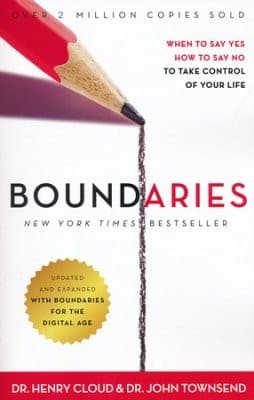
Boundaries
by Henry Cloud, John Sims Townsend
Henry Cloud and John Townsend's classic offers a clear test for where your responsibility ends and someone else's begins, with practical language for saying no.
What It's About
Boundaries, first published in 1992, is a book by Henry Cloud and John Townsend about where you end and other people begin. Its core claim is that many people struggle not because they lack willpower but because they are unclear about what they are responsible for and what they are not. The authors frame boundaries as a practical way to take ownership of your own choices, feelings, and time.
The style is pragmatic and case-driven. Chapters are built around recognizable situations, such as relatives who guilt-trip, friends who always need rescuing, and workplaces that keep adding demands, followed by diagnosis and concrete steps. The authors draw heavily on biblical passages, so the faith framing runs through much of the text, though the underlying ideas can be adapted by secular readers. Expect illustrations, self-examination questions, and direct language rather than dense theory.
Reading it feels less like absorbing new information and more like being held up to a mirror. Many readers recognize themselves in the inability to refuse or in the controlling patterns they have fallen into. The most useful sections help you tell the difference between setting a limit and trying to manage another person, and they leave you with a clearer sense of what you can actually change.
Read this if you…
- keep agreeing to things you resent and want a practical way to change that
- feel responsible for other adults' moods, choices, or problems
- are comfortable with a faith-informed framework and scripture references
Skip it if you…
- want a secular, research-driven self-help book
- are in an abusive or unsafe relationship and need specialized guidance rather than general advice
Key Ideas
- 1
Boundaries mark responsibility, not walls
The central move is separating what belongs to you, such as your choices, attitudes, time, and effort, from what belongs to other people. Many problems come from carrying others' feelings or consequences. Drawing this line clearly gives you a basis for deciding when to help and when to step back.
- 2
Saying no as a learnable skill
The authors treat difficulty refusing as a pattern rooted in fear of conflict, guilt, or a need for approval, not as a fixed trait. They explain why people overcommit and how a refusal can be given without long justifications or hostility. The emphasis is on practical wording more than abstract theory.
- 3
Influencing others versus controlling them
A recurring theme is that trying to manage another person's behavior through pressure, rescue, or manipulation is itself a boundary problem. The book distinguishes honest influence from control and points your energy back toward your own responses, which many readers find the most challenging idea.
- 4
Letting consequences do their teaching
The authors argue that shielding people from the results of their own choices, in families and at work, can be less loving than it looks. This idea is applied with care, but it is one of the more debated parts of the book and needs thoughtful judgment in real situations.
Limitations
The book's scripture-heavy approach can put off readers who do not share the Christian framing, and the authors' argument rests partly on that foundation. Some examples and language reflect the early 1990s. Some critics feel the consequence-based advice can be pushed too far, encouraging people to distance themselves from family quickly. It does not deal deeply with trauma, abuse, or mental illness, so it works best alongside professional support when those issues are present.
Questions Readers Ask
- Is Boundaries still relevant today?
- The core ideas about responsibility, saying no, and avoiding control remain widely useful, and the book is still widely read. Some examples and phrasing feel dated, and the Christian framing is central to the text. Readers who want more on trauma or attachment may find newer books add important nuance.
- Is it useful for readers without a religious background?
- Yes, with some adaptation. The psychological principles can be separated from the scripture references, which you can skim or reread as you prefer. The chapters on family relationships tend to carry the most practical weight for most readers.
- How does it compare to other boundary books?
- It is less theoretical than many newer titles and more structured than general self-help. Readers wanting a deeper look at emotional patterns and their origins may prefer a therapy-based book that goes further into that territory.
- Published
- 1992
- ISBN
- 9780310585909
- Difficulty
- beginner
- Category
- Self-Improvement
Book details and cover from Google Books.
Ready to read Boundaries?
Get your copy on Amazon, or listen to it on Audible. We earn a commission if you buy through these links.