
We earn a commission if you buy through these links. Learn more
Blue ocean strategy
by W. Chan Kim
A practical, widely taught case for escaping crowded markets by creating demand rather than fighting for share, with tools managers can use in planning meetings.
What It's About
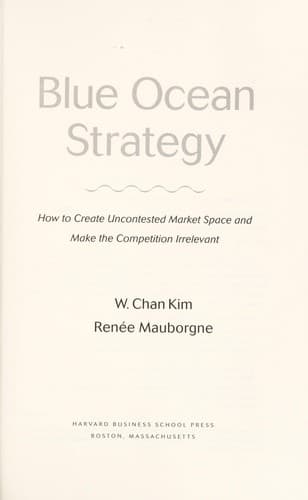
Blue Ocean Strategy, written by W. Chan Kim with Renée Mauborgne and first published in 2005, is a business book about where companies choose to compete. Its central claim is that most firms fight for share in crowded markets where the rules are known and margins keep shrinking. The authors argue that a more profitable path is to create uncharted market space where competition matters less, because the company offers buyers something they have not had before.
The book is built around practical tools rather than abstract theory. The Strategy Canvas plots an industry's competitive factors against how each rival invests in them, making it easy to see where everyone is crowding together. The Four Actions Framework then asks which factors to eliminate, reduce, raise, or create. Much of the text is illustrated with case stories from several sectors, told as narratives that show the thinking behind each move.
Reading it feels more like sitting through a long, energetic workshop than working through a textbook. The tone is confident, the diagrams are frequent, and the argument repeats itself on purpose. You come away with a vocabulary for strategy conversations and a checklist for questioning industry assumptions, though the book gives less help on the hard work of carrying a new idea through a real organization.
Read this if you…
- are a manager, founder, or product leader who needs shared language for rethinking a crowded market
- want a structured way to challenge assumptions about pricing, features, and what customers really value
- enjoy persuasive business narratives and don't mind a repetitive, emphatic style
Skip it if you…
- want rigorous evidence that blue ocean moves reliably succeed in practice
- need detailed guidance on financing, operations, or implementation in a specific industry
Key Ideas
- 1
Red oceans versus blue oceans
Red oceans are existing industries with defined boundaries, where companies compete for a share of known demand. Blue oceans are markets that do not yet exist in practice, where demand is created rather than captured. The authors stress that blue oceans are built by deliberate choices, not stumbled upon, and the contrast gives managers a simple lens for asking where their effort is going.
- 2
Value innovation
Value innovation means pursuing differentiation and lower cost at the same time, instead of accepting a trade-off between them. The idea is that a company can cut its cost structure while raising what buyers receive by rethinking what the product is for. The book pushes readers to ask which features customers actually value and which ones add cost without adding benefit.
- 3
The Strategy Canvas and Four Actions
The Strategy Canvas is a chart that compares an industry's competitive factors and how each player scores on them, producing a visual profile of the market. The Four Actions grid then asks what to eliminate, reduce, raise, and create relative to that profile. These tools are the most reusable part of the book and are simple enough to run in a team workshop.
- 4
Fair process and execution
The authors argue that a new strategy succeeds or fails on whether frontline managers understand and trust it. Their principles of fair process centre on engaging people in the decision, explaining the reasoning behind it, and setting clear expectations. This section is short, but it addresses a problem many strategy books ignore: getting a good idea adopted.
Limitations
The most common criticism is that the evidence is selective. The case studies are chosen to illustrate success, and the authors' sample of past strategic moves can read as hindsight presented as method. Critics also note that many supposed blue oceans are copied within a few years, and that the framework describes what worked better than it predicts what will. The book is lighter on failure, on the financial risk of new markets, and on how to tell a genuinely uncontested space from a small niche.
Questions Readers Ask
- Is Blue Ocean Strategy still relevant?
- Yes, mainly as a set of thinking tools. The Strategy Canvas and Four Actions remain widely taught in business courses and planning sessions. The broader promise that a company can reliably escape competition is more contested today, given fast-moving digital markets and quick copycats, so it is best read as a prompt for questioning assumptions rather than a guaranteed playbook.
- How does it compare to Porter's Five Forces?
- Porter's Five Forces analyzes the pressures shaping an existing industry, helping you defend a position inside it. Blue Ocean Strategy starts by asking whether that industry's boundaries are worth accepting at all. Many strategists use both: Five Forces to understand the terrain, and the blue ocean tools to look for a different terrain to compete on.
- Who should read it first?
- Managers, founders, and marketing or product leaders working in crowded categories will get the most out of it, especially if they run regular planning meetings. Business students will find it a clear introduction to strategy. Readers who want deep financial or operational detail should look for a more specialized book.
- Published
- 2005
- ISBN
- 9781591396192
- Difficulty
- intermediate
- Category
- Business
Book details and cover from Google Books.
Ready to read Blue ocean strategy?
Get your copy on Amazon, or listen to it on Audible. We earn a commission if you buy through these links.