
We earn a commission if you buy through these links. Learn more
Blue nights
by Joan Didion
Guide by the Books of the Day editors · Updated · How we write our guides
A raw, fragmented memoir of a mother trying to make sense of her adult daughter's death and her own failing body, written by one of America's sharpest prose stylists.
What Creators Say About Blue nights
2 creators reviewed Blue nights on YouTube between 2020 and 2022, with 1.4K views between them. Their opinions are their own; we picked these reviews, we didn't write them.
What It's About
Blue Nights is Joan Didion's 2011 follow-up to The Year of Magical Thinking, which dealt with the sudden death of her husband, John Gregory Dunne. This book turns to their adopted daughter, Quintana Roo, who died in 2005 after a long illness, and it is written from the vantage of a woman in her seventies who is confronting her own frailty. The title refers to the long twilight at the end of a summer day, when the light lingers and then fades into something harder to see.
The form is the point. Didion works in short fragments, returns to the same images, pauses over photographs and family facts, and circles back on memories with the nagging logic of someone checking whether she got something right. Her plain sentences carry a great deal of dread. Reading it feels less like following an argument than sitting beside someone while she rereads old letters and a box of snapshots.
It is a slim book but an emotionally demanding one. Expect repetition, unresolved questions about parenting and fault, and a narrator who is often candid about her fears and her gaps. The pleasure lies in the precision of the observation and the rhythm of the prose, even when the subject is grief.
Read this if you…
- you want a close, unsentimental look at grief from a writer known for her control of language
- you have read The Year of Magical Thinking and want to see where Didion's story goes next
- you are interested in how memoir can be built from fragments rather than a linear narrative
Skip it if you…
- you want a clear story with a beginning, middle, and resolution or a sense of consolation at the end
- you are not ready for a book that stays with loss and mortality for its entire length
Key Ideas
- 1
Grief that arrives out of order
Losing a child reverses the expected sequence of life, and the book examines the particular helplessness of a parent who cannot protect a grown child. Didion returns again and again to the question of what she could have seen or done sooner, and she refuses to settle it with easy comfort.
- 2
Parenthood as a record of doubt
The narrator interrogates her own choices as a mother, including the decision to adopt and how well she understood the daughter she raised. The book does not offer absolution, and that refusal is part of what gives it its force.
- 3
Aging as a quiet loss of control
Alongside the grief runs a close attention to her own aging: bodily weakness, memory, and the fear of ending up alone and dependent. These passages connect the private loss to a broader meditation on what time takes from everyone.
- 4
Memory as an unreliable archive
Didion leans on photographs, letters, and recorded facts, then shows how little they can hold. Language strains to reconstruct a life, and the reader sees the gap between the record and the experience it was meant to preserve.
Limitations
Critics often find the fragmented structure repetitive, and some readers feel the book circles its central wound without fully opening it. Quintana appears mostly through her mother's recollections and uncertainties, so readers looking for a fuller portrait of the daughter as a person may feel shortchanged. The narrator's privileged world and her focus on her own anxieties can also feel narrow to some. The book asks for patience and tolerance of uncertainty, and it offers few answers.
Questions Readers Ask
- Do I need to read The Year of Magical Thinking first?
- You don't need it, but the books are closely connected. Magical Thinking covers the death of Didion's husband and the months that followed, and Blue Nights assumes you know that loss already. Reading them in order gives you the fuller arc of the period, though Blue Nights can stand on its own.
- Is Blue Nights too sad to be worth reading?
- It is very sad, and it does not offer much consolation. Readers who want to understand grief and aging in unflinching terms often find it rewarding. Readers who are currently in acute grief may find it too close to their own experience and might prefer to wait.
- Published
- 2011
- ISBN
- 9780007432912
- Difficulty
- intermediate
- Category
- Biographies
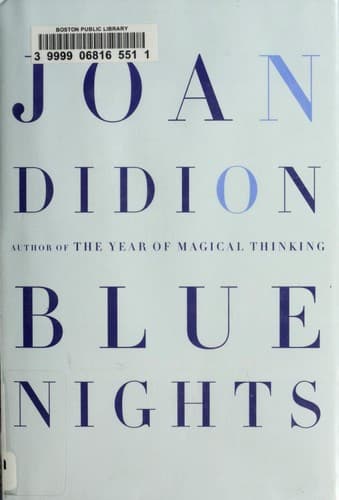
Book details and cover from Google Books.
Ready to read Blue nights?
Get your copy on Amazon, or listen to it on Audible. We earn a commission if you buy through these links.