
We earn a commission if you buy through these links. Learn more
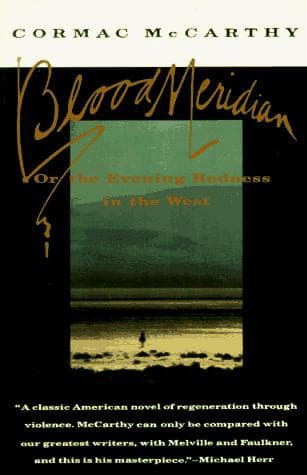
Blood Meridian
A brutal, lyrical frontier epic that rewards slow, attentive readers willing to sit with its violence and its unforgettable antagonist, Judge Holden.
What It's About
Blood Meridian, published in 1985, follows a teenager known only as 'the kid' as he drifts from Tennessee into the Texas and Mexican borderlands in the late 1840s. He falls in with a band of paid scalp hunters led by Captain John Glanton, men who collect bounties for Apache scalps. McCarthy draws loosely on the real history of the Glanton gang, but he reshapes events into something closer to myth. The book's center of gravity is Judge Holden, a towering, hairless, eloquent figure whose presence becomes the most unsettling thing on every page.
The prose is the main event. McCarthy writes without quotation marks, strings clauses together with long runs of 'and,' and favors a biblical, incantatory rhythm that can feel like weather moving across the desert. The violence is frequent and physically exact, and the narrator rarely pauses to explain or comfort. Reading it is less like following a conventional plot than moving through a sequence of landscapes, camps, and killings, with long stretches of travel that are meant to feel monotonous and endless.
It is a demanding book that resists easy sympathy, clear motivation, and a tidy moral arc. The experience is bleak, hypnotic, and sometimes numbing, closer to an epic poem or a nightmare than to standard historical fiction. Many readers finish it feeling they have witnessed something rather than simply read a story.
Read this if you…
- want a demanding literary novel with a truly distinctive voice
- are interested in the darker, historical side of the American West
- can handle graphic violence and want a book that stays with you for years
Skip it if you…
- want a plot-driven story with clear heroes and a satisfying arc
- find graphic cruelty hard to read, even when it serves a serious purpose
Key Ideas
- 1
Violence as the book's central subject
Blood Meridian is less interested in plot than in what violence does to people and to the idea of a civilized society. The killings are numerous and rendered with unflinching precision, and the book keeps asking why such cruelty seems so natural to the men who commit it. Readers should expect the violence to be the point, not a backdrop.
- 2
Judge Holden as a figure of war and reason
Holden is a learned, articulate man who talks about history, nature, and war with unnerving confidence. He is hard to categorize as hero or villain, and that ambiguity is deliberate. Much of the novel's unease comes from how persuasive and at ease he is among the violence he seems to embody.
- 3
Language as an instrument of the novel
McCarthy's sentences are dense, archaic in places, and built for rhythm rather than easy comprehension. The stripped punctuation makes dialogue blur into the narration, so the reader has to work to follow who is speaking. The style is part of the book's argument: the world it describes resists tidy description.
- 4
A deliberate critique of the frontier myth
Blood Meridian treats the American West not as a heroic story of expansion but as a place of greed, racial hatred, and moral emptiness. The novel is often read as a direct challenge to the romantic Western. It offers no clean lessons about progress or courage, only a grim accounting of what was done and who paid for it.
- 5
The kid as a near-blank center
The protagonist is young, largely unnamed, and often passive, carried along by events more than shaping them. This makes him a lens rather than a hero, which can frustrate readers who want a character to root for. His ambiguity pushes attention outward, onto the landscape and the men around him.
Limitations
The violence is relentless and is the main reason many readers put the book down, and some critics argue that the repetition numbs more than it illuminates. The novel gives little interiority to its Mexican and Native characters, who often appear as targets rather than people, a choice defenders call deliberate and critics find troubling. Some readers also find Judge Holden's monologues overbearing, and the long desert passages can feel monotonous. The book is not a historical account, so readers wanting accuracy should look elsewhere.
Questions Readers Ask
- Is Blood Meridian based on real events?
- Loosely. The novel draws on the Glanton gang, a group of scalp hunters who operated in the borderlands around 1849 and 1850 and collected bounties for Apache scalps. McCarthy invents the kid and Judge Holden and reshapes events freely. It is best read as a mythic reimagining of that history rather than as a documentary account.
- How does it compare to No Country for Old Men?
- Both are spare and violent, but Blood Meridian is far more expansive, historical, and mythic. No Country for Old Men is more plot-driven and easier to follow. Blood Meridian asks more of the reader in language and patience, and many people who love McCarthy consider it his most ambitious work.
- Do I need to like Westerns to enjoy it?
- No. The book works more as an anti-Western than a traditional one, with little of the romance, heroism, or tidy justice that genre fans expect. Readers who enjoy literary fiction about violence, history, and language often find it more rewarding than readers who simply love the Western format.
- Published
- 1985
- ISBN
- 9780330544580
- Difficulty
- advanced
- Category
- Fiction
Book details and cover from Google Books.
Ready to read Blood Meridian?
Get your copy on Amazon, or listen to it on Audible. We earn a commission if you buy through these links.