
We earn a commission if you buy through these links. Learn more
Bitter fruit
by Stephen C. Schlesinger, Stephen Schlesinger
A clear, angry account of how the United States helped topple Guatemala's elected government in 1954, and why that decision still shapes Central American politics today.
What It's About
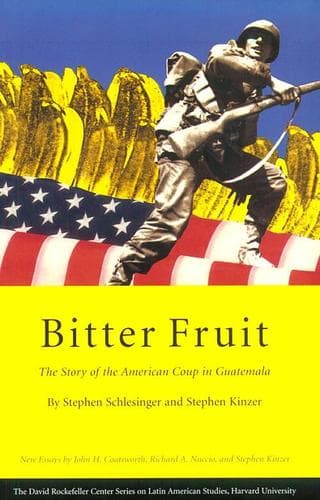
Bitter Fruit, written by Stephen Kinzer and Stephen C. Schlesinger and first published in 1982, tells how the United States helped overthrow Guatemala's elected president, Jacobo Árbenz, in 1954. The authors reconstruct the chain of decisions that led there: a land reform law that threatened the holdings of the United Fruit Company, a lobbying and public relations effort that cast Árbenz as a Soviet ally, and a covert operation that installed Carlos Castillo Armas in his place. The story stays concrete, focused on specific policies, company interests, and officials whose legal and business ties blurred into foreign policy.
The approach is narrative reportage rather than dense theory. The book follows the people who made choices, from corporate executives to government officials, and shows how the coup was planned and sold to the public as a defense against communism. It is built on documents and interviews available at the time, and it presents the overthrow as a deliberate act rather than an accident of the Cold War. The tone is angry but controlled, and the authors make their case mostly through evidence.
Reading it feels like working through a case file that grows darker as it goes. The later sections trace what followed the coup: military rule, repression, and a long internal conflict. It is a direct, readable book that works well as an introduction to Guatemalan history and to the mechanics of covert action.
Read this if you…
- want a clear, well-sourced introduction to US intervention in Latin America during the Cold War
- are interested in how business interests and government policy can intertwine
- prefer narrative history that reads like a investigation to a dry academic survey
Skip it if you…
- want a balanced account centered on Guatemalan voices and the country's internal politics
- need the most current scholarship, since the book predates many later archival studies
Key Ideas
- 1
Land reform as the trigger
The book starts from Árbenz's agrarian reform, which redistributed unused land, including large plantation holdings. Seeing the reform as a threat to property and profit, the authors argue, is essential to understanding why Washington turned against the government. The conflict was not simply about communism but about who controlled Guatemala's land and labor.
- 2
Corporate interests shaping policy
The authors show how the United Fruit Company used its connections in Washington to shape official views of Guatemala. Legal and personal ties between business and government officials meant that a private grievance could be pursued with the full resources of the state. This is the book's most lasting warning about the blurred line between commercial and national interests.
- 3
Cold War anticommunism as justification
Anticommunism provided the language that made intervention acceptable to the public and to policymakers. The book examines how evidence of communist influence was inflated and how a campaign of press coverage framed a reformist government as a security danger. It asks readers to notice how easily a political fear can override a careful reading of facts.
- 4
A covert operation and its aftermath
The coup is presented as a planned covert campaign whose success depended on propaganda, pressure, and a small number of key actors. The authors also trace its consequences, arguing that the installation of a repressive government helped set the stage for decades of violence. The later chapters make clear that the overthrow was a turning point, not a closed episode.
Limitations
Written in 1982, before many U.S. and Guatemalan archives were opened, the book reflects the evidence available at the time and has been refined by later research. Its focus is mainly on American decision-makers and the company, so Guatemalan reformers, indigenous communities, and ordinary citizens get less space than they deserve. Some critics argue the narrative leans toward a single villain and gives less attention to the Árbenz government's own mistakes. The book concentrates on the coup and its immediate aftermath, so the long civil war that followed is only sketched.
Questions Readers Ask
- Is Bitter Fruit still relevant today?
- Yes, especially for understanding Guatemala's civil war and US policy toward Central America. Some details have been revised by later archival research, so it works best as a foundation rather than the final word. Pairing it with newer scholarship gives a fuller picture of the period.
- Who is Bitter Fruit best suited for?
- It suits general readers curious about Latin American history, the Cold War, or the influence of corporations on foreign policy. You do not need prior background, since the authors explain the context as they go. Readers who want a detailed academic analysis may find it too brief and too focused on American actors.
- Published
- 1982
- ISBN
- 9780674260078
- Difficulty
- beginner
- Category
- History
Book details and cover from Google Books.
Ready to read Bitter fruit?
Get your copy on Amazon, or listen to it on Audible. We earn a commission if you buy through these links.