
We earn a commission if you buy through these links. Learn more
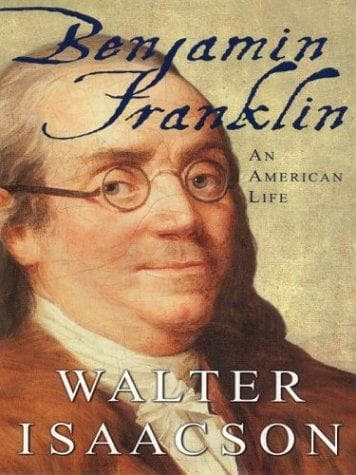
Benjamin Franklin
by Walter Isaacson, Boyd Gaines
Guide by the Books of the Day editors · Updated · How we write our guides
Isaacson's 2003 biography shows how Franklin's habits of practical experiment, public service, and self-improvement built a republic's most useful founder.
What It's About
Walter Isaacson's Benjamin Franklin: An American Life follows Franklin from a Boston boy apprenticed to his older brother's printing shop to the elderly statesman who signed both the Declaration of Independence and the Constitution. Along the way it covers his years as a printer and almanac writer, his civic projects in Philadelphia, his electrical experiments, his long stretches in London as a colonial agent, and his decade in France as America's diplomat during the Revolution.
Isaacson's approach is chronological and narrative, with a clear interest in what made Franklin effective. He treats Franklin less as a dazzling eccentric and more as a problem-solver who preferred clubs, committees, and working agreements to grand gestures. The book leans on Franklin's own letters and his unfinished autobiography, so you hear his voice often, and Isaacson pays steady attention to the gap between the self-made sage Franklin presented to the world and the more complicated man behind it.
Reading it feels like spending a long evening with a patient, well-informed guide. The pace is brisk for a book of this length, and the prose is clear rather than ornate. The audio edition is narrated by Boyd Gaines, who is credited on this listing; the text itself is Isaacson's.
Read this if you…
- want a full, readable life of Franklin that connects his inventions, politics, and diplomacy
- are curious how a self-made printer became one of the most influential founders
- prefer narrative history grounded in the subject's own letters and writings
Skip it if you…
- want a scholarly, footnote-heavy study of the eighteenth-century Atlantic world
- are looking for a close analysis of Franklin's writing style or literary craft
Key Ideas
- 1
Practical virtue as a working philosophy
Franklin's famous lists of personal virtues were not idle moralizing. Isaacson argues they were tools he tested and revised over decades, and that his ethics were measured by what worked in daily life and public affairs. The book shows how this habit of self-testing shaped nearly everything he did.
- 2
Building institutions through voluntary groups
Franklin repeatedly created small associations that outlasted him: a debating club, a lending library, volunteer fire companies, and later academies and hospitals. Isaacson presents these as the core of his civic genius, a belief that communities improve through cooperation among ordinary people rather than through decrees.
- 3
Curiosity that always returned to use
His scientific work, from electricity to stoves to bifocals, was driven by a desire to explain phenomena and make them useful. Isaacson frames Franklin as a scientist whose experiments were practical, and whose refusal to patent many inventions reflected his conviction that knowledge belonged to everyone.
- 4
A public persona built with care
Franklin cultivated the plain-spoken, almanac-writing image of Poor Richard, and Isaacson examines how deliberately he managed his reputation in Britain, France, and America. The book takes this self-presentation seriously, neither dismissing it as vanity nor accepting it at face value.
- 5
Diplomacy as the art of persuasion
Isaacson gives substantial space to Franklin's years in London and Paris, where his skill at personal relationships, patience, and reading other people mattered as much as formal argument. He argues that these talents helped secure the French alliance that made American independence achievable.
Limitations
Some critics find Isaacson too admiring of Franklin and too quick to smooth over his contradictions, including his involvement in slavery, his complicated treatment of his family, and his shifting positions during the imperial crisis. The book covers his science and diplomacy in broad strokes, so readers wanting technical depth on either will need other sources. Its focus on Franklin's character and achievements means the perspectives of the many people around him receive less attention than they might.
Questions Readers Ask
- Is this biography a good starting point for learning about Franklin?
- Yes. Isaacson's book is one of the most accessible full-length lives of Franklin and gives a solid overview of his career from printing to diplomacy. Readers who want more of Franklin's own voice can read his autobiography afterward, since Isaacson quotes it often and it stands well on its own.
- How does it compare to H.W. Brands' biography of Franklin?
- Both are readable, single-volume lives of Franklin. Isaacson tends to emphasize Franklin's character and public habits, while Brands gives a more detailed account of his political and diplomatic work. If you want the sharper focus on the Revolution's politics, Brands is a useful companion; if you want a warmer, more personal narrative, Isaacson fits well.
- Is it still worth reading in light of newer scholarship?
- Yes, though it is best read with some awareness of later work. Historians have since paid more attention to slavery, women, and the perspectives of people outside Franklin's circle. Isaacson's book remains a reliable, engaging introduction, and pairing it with newer scholarship gives a more complete picture.
- Published
- 2003
- ISBN
- 9780743258074
- Difficulty
- intermediate
- Category
- Biographies
Book details and cover from Google Books.
Ready to read Benjamin Franklin?
Get your copy on Amazon, or listen to it on Audible. We earn a commission if you buy through these links.