
We earn a commission if you buy through these links. Learn more
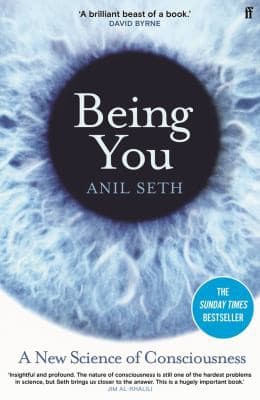
Being You
by Anil Seth
Anil Seth shows how the brain constructs everything you experience, including your sense of self, and why consciousness may be rooted in staying alive.
What It's About
Seth, a neuroscientist at the University of Sussex, takes on the question of how a lump of nervous tissue produces subjective experience. His central move is to treat perception as a controlled hallucination: the brain constantly predicts what its senses should report and updates those predictions with incoming signals. Seeing, in this view, is less like receiving a photograph and more like making an informed guess.
The book then pushes this idea further, arguing that the self is also a prediction, grounded in the body rather than in some hidden inner observer. Much of the most interesting material concerns how emotion, mood, and feelings of being alive are tied to the brain regulating the body. Seth also distinguishes between the hard problem and what he calls the real problem: explaining the particular features of experience instead of asking why there is experience at all.
Reading it feels like a guided tour through perception research, illusions, hallucinations, and altered states, written in a conversational, lucid voice with frequent everyday examples. It is not a dense textbook, but it asks you to hold abstract models in mind and to accept a few speculative leaps, especially toward machine consciousness. The payoff is a changed sense of how ordinary your own experience already is.
Read this if you…
- are curious how the brain turns electrical signals into a vivid experience of the world
- want a grounded, science-based account of perception and selfhood without heavy jargon
- enjoy thinking about illusions, altered states, or whether machines could ever be conscious
Skip it if you…
- want a definitive answer to the hard problem of consciousness
- prefer a rigorous technical treatment with equations and detailed experimental protocols
Key Ideas
- 1
Perception as controlled hallucination
Seth argues that what you see, hear, and feel is the brain's best guess about the causes of its sensory input, checked and corrected against the world. Illusions and dreams become useful evidence rather than curiosities. The idea reframes ordinary perception as an active process of prediction, which changes how you think about the reliability of your own senses.
- 2
The self as a body-based prediction
Rather than a fixed inner essence or a little observer behind the eyes, the self is presented as another perceptual construction. Seth breaks it into layers, such as the sense of owning a body and the sense of perspective, and shows how each can be altered. The argument makes selfhood feel more fragile and more interesting than the everyday assumption that it is simply there.
- 3
Feeling alive as biological regulation
A distinctive strand of the book links conscious experience to the brain's ongoing management of the body's internal state. Emotions and moods are described as predictions about bodily needs, not just reactions to events. This grounding in physiology gives the book a practical tone and suggests consciousness may be bound up with the basic task of staying alive.
- 4
Shifting from the hard problem
Seth proposes setting aside the question of why experience exists at all and focusing on the real problem: explaining the specific properties of experience and linking them to measurable brain processes. This reframing is central to his case. Readers who find the hard problem frustrating will find the approach refreshingly pragmatic, though philosophers may see it as sidestepping the deepest question.
Limitations
Seth's predictive framework is one of several competing theories of consciousness, and critics argue it explains the mechanisms of perception more convincingly than it explains why any of this feels like something. Some readers find the speculative sections on artificial minds and the future of machine consciousness less grounded than the core chapters. The book draws heavily on the author's own research program and Western scientific work, so rival theories receive comparatively brief treatment. Its ideas have also been developed further since publication.
Questions Readers Ask
- Is Being You still relevant?
- Yes. The predictive processing ideas it popularized remain central to consciousness research, although the field has moved on since publication. Treat its theories as strong current hypotheses rather than settled answers, and look at more recent work if you care most about the questions around artificial intelligence and machine consciousness.
- How does it compare to Dennett's Consciousness Explained?
- Dennett's book is longer, more philosophical, and more demanding, building a sustained argument against the idea of a central theater of experience. Seth's book is more empirical and more focused on perception and the body. Choose Seth for an accessible, grounded introduction, and Dennett if you want the full philosophical case.
- Published
- 2021
- ISBN
- 9781524742874
- Difficulty
- intermediate
- Category
- Psychology
Book details and cover from Google Books.
Ready to read Being You?
Get your copy on Amazon, or listen to it on Audible. We earn a commission if you buy through these links.