
We earn a commission if you buy through these links. Learn more
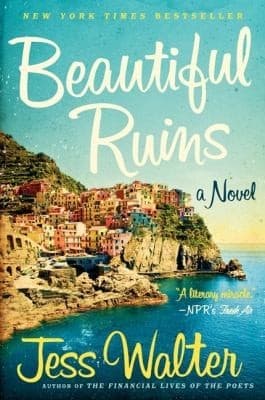
Beautiful Ruins
by Jess Walter
A sun-soaked, bittersweet novel that braids a 1962 Italian coast romance with a sharp, funny look at Hollywood's appetite for reinvention, held together by a generous, hopeful heart.
What It's About
Beautiful Ruins follows a loose ring of characters whose lives brush against one another across more than four decades. The story opens in 1962 in Porto Vergogna, a fictional fishing village on the Italian coast, where Pasquale, a young innkeeper with big dreams, meets Dee Moray, an American actress who has arrived while a lavish film is being shot in Rome. Decades later, the narrative moves to present-day Hollywood, where a jaded producer and a cast of hangers-on are trying to salvage a project of their own. The threads slowly converge, and the connections are more satisfying for taking their time.
Walter writes in a warm, wry voice, moving between eras and viewpoints and slipping in documents, asides, and short detours that reveal more about each character than a conventional scene would. The tone is comic in the dialogue and quietly sad underneath, and the book is more interested in tenderness than in cynicism about the film business. Reading it feels like being let in on a long, good conversation with someone who knows everyone's secrets and is happy to tell you most of them.
Underneath the plot is a question about whether a person can genuinely start over, and what the past is owed when a new life is built on top of it. The novel is more about second chances and the stories people tell to survive than about any single event, so it rewards patience and a willingness to follow several people at once.
Read this if you…
- Enjoy warm, funny fiction with a melancholy undertow
- Like novels that jump across decades and follow several people at once
- Are curious about Hollywood's myths told with more heart than cynicism
Skip it if you…
- Want a tightly plotted thriller or a single, linear story
- Find sentimental endings or romance-heavy plots hard to enjoy
Key Ideas
- 1
Reinvention as rescue and as performance
Several characters are trying to become someone new, whether through a fresh start in a small town or a carefully managed image in Hollywood. Walter shows how reinvention can be genuine and how it can be a sales pitch, and he is curious about where the line falls. The book treats the desire for a second act as deeply human, even when the people chasing it are a little ridiculous.
- 2
A brief encounter that outlasts its moment
The 1962 meeting between Pasquale and Dee is short, but its afterglow shapes decades of choices on both sides. Walter is interested in how a single intense moment can become a story people keep retelling, and how memory tends to improve or distort what actually happened. Love here is less a grand passion than a turning point that refuses to stay in the past.
- 3
Satire of Hollywood with genuine affection
The present-day sections poke fun at studio politics, celebrity publicity, and the endless pitching of projects that may never get made. The jokes land because the characters are drawn with sympathy rather than contempt. Walter seems to like the people in this world even while he is clear-eyed about its vanity and hustle.
- 4
Shifting time and perspective as a method
The novel moves between decades and between points of view, letting older events surface through what characters later remember or discover. The structure asks readers to assemble the picture themselves, rewarding attention with payoffs that feel earned rather than contrived. Expect to flip back in time more than in a straight novel.
- 5
Ordinary lives at the edges of fame
Some of the most affecting characters are not stars at all but villagers, assistants, and people who orbit the glamour without sharing it. Walter gives these figures real interiority, which keeps the book from becoming a simple fairy tale about movies. Their modest hopes carry as much weight as the famous characters' dramas.
Limitations
Some readers find the book sprawling, with so many threads and time jumps that certain characters feel underdeveloped or arrive late in the story. The Hollywood satire can lean broad at times, and a few sections may feel like detours. The romance of the Italian coast is idealized, and the village is more a symbol than a fully observed place. Readers wanting a tightly plotted, single-timeline novel may find the drift frustrating, and the sentimental streak will not suit everyone.
Questions Readers Ask
- Is Beautiful Ruins a good choice for a book club?
- Yes. It has many talking points: second chances, the price of fame, how memory shapes love, and whether stories can be trusted. Its length is manageable, the prose is accessible, and the multiple perspectives give groups plenty to compare. Expect disagreement over the Hollywood sections, which some members will find the most fun and others the least engaging.
- Do I need to know old Hollywood history to enjoy it?
- No. The 1962 film shoot is background texture rather than a test. Readers who know the famous productions of that era may catch echoes, but the story stands on its own characters. You do not need any film history to follow the plot or feel the emotional pull of the book.
- Published
- 2012
- ISBN
- 9780670922659
- Difficulty
- beginner
- Category
- Fiction
Book details and cover from Google Books.
Ready to read Beautiful Ruins?
Get your copy on Amazon, or listen to it on Audible. We earn a commission if you buy through these links.