
We earn a commission if you buy through these links. Learn more
Barefoot Gen
Keiji Nakazawa's semi-autobiographical manga shows the atomic bomb from inside an ordinary working family's daily struggle, making it one of the most unflinching accounts of Hiroshima available.
What It's About
Barefoot Gen is a manga by Keiji Nakazawa, who was a child in Hiroshima when the atomic bomb fell in August 1945. The story follows a boy named Gen Nakaoka and his family through the last months of the war and its immediate aftermath. Nakazawa draws heavily on his own memories, so the book reads as a personal testimony shaped into a narrative rather than a neutral historical survey.
The approach is blunt. Gen's father openly opposes the militarist government in a society where that is dangerous, which gives the early sections a steady undercurrent of fear. Hunger is a constant presence: the family is short of food, and scrounging, small kindnesses and daily survival drive much of the action. The black-and-white art is expressive and often brutal. The bombing and its aftermath are rendered without softening, with burns, bodies and sickness shown directly.
Reading it is an intense, sometimes exhausting experience, but it is also surprisingly warm. Family loyalty and moments of humor keep the book from becoming only a catalogue of suffering. It is written for a broad readership, including young readers, though its content is not gentle. Expect to read it slowly and to keep thinking about it long after you finish.
Read this if you…
- want a firsthand, emotionally direct account of the bombing of Hiroshima
- are interested in how comics can carry serious historical and moral weight
- want to understand the wartime home front in Japan from the perspective of ordinary people
Skip it if you…
- need a balanced history of the Pacific War, including Japan's role as an aggressor
- find graphic depictions of injury and death too distressing to read
Key Ideas
- 1
Ordinary life under a militarist state
The book shows how wartime propaganda, rationing and neighborhood pressure shaped everyday life long before the bomb fell. Nakazawa treats the home front as a place where ideology was enforced through small humiliations and fear, not just through distant battles. This context matters because it explains why a family like Gen's could be treated as suspect for simply speaking honestly.
- 2
Dissent inside a single family
Gen's father's refusal to go along with the war becomes the emotional spine of the early story. His stubbornness puts his household at risk and tests the bonds between parent and child. The book asks what courage costs when it is paid by people who never chose to be heroes.
- 3
Hunger and the work of staying alive
Food, fuel and shelter are never background details here. Much of the drama comes from the practical grind of getting through each day, which makes the characters feel concrete and makes the disaster feel like an interruption of a life already under strain.
- 4
The bomb as lived experience
Instead of abstract statistics, the book stays close to individual bodies, neighborhoods and small decisions. That closeness is what makes it hard to read and what makes its anti-war argument land. It shows destruction as something that happens to particular people with names and habits.
- 5
Solidarity and hope amid devastation
Alongside the horror, the book keeps returning to acts of care between neighbors and family members. These moments do not erase the suffering, but they give the story a human warmth and suggest that the will to rebuild is part of the message.
Limitations
The book is told from one family's perspective and is deliberately focused on Japanese civilian suffering, so it does not explore the wider causes of the war or the experiences of other victims in depth. Its anti-war stance is pointed and some readers find it one-sided. The episodic structure can feel uneven, and the art style, while powerful, is not polished in the way some modern manga are. Readers should also consider the English translations' differences and the book's strong emotional tone when judging how it fits their needs.
Questions Readers Ask
- Is Barefoot Gen suitable for teenagers?
- Many teenagers read it, and it is often taught in schools, but it contains graphic images of burns, death and sickness. It works best for readers who can handle direct depictions of violence and who might benefit from discussing it with an adult. Readers who are sensitive to disturbing imagery should be prepared before starting.
- How does it compare to other books about Hiroshima?
- Unlike prose histories or survivor testimonies collected by researchers, Barefoot Gen is a fictionalized narrative drawn from the author's memories. It offers a more personal and visual experience, though it trades the breadth and documentation of nonfiction accounts for emotional immediacy.
- Published
- 1995
- ISBN
- 9780867194531
- Difficulty
- beginner
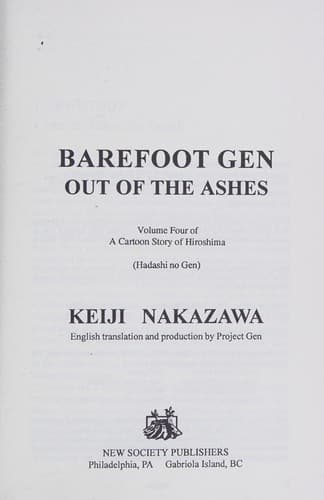
Book details and cover from Google Books.
Ready to read Barefoot Gen?
Get your copy on Amazon, or listen to it on Audible. We earn a commission if you buy through these links.