
We earn a commission if you buy through these links. Learn more
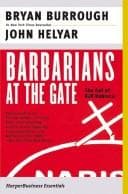
Barbarians at the gate
by Bryan Burrough, John Helyar
A dramatic, meticulously reported account of the 1988 fight over RJR Nabisco that shows how Wall Street deals, corporate ego, and money collided.
What It's About
Barbarians at the Gate is a reported narrative of one of the most famous corporate takeover fights of the 1980s: the attempt in 1988 to buy RJR Nabisco, the food and tobacco conglomerate, through a leveraged buyout. The authors, both reporters who covered business for The Wall Street Journal, reconstruct the bidding war from the inside, moving between boardrooms, investment banks, and private deal rooms. The result reads more like a thriller than a finance textbook, and its cast of executives, dealmakers, and bankers is large enough that a reader needs to keep track of who wants what.
The book's engine is personality. Its central figure, Ross Johnson, the charismatic chief executive, is portrayed as a man who enjoyed lavish spending and his own reputation, and the story turns on how his management buyout proposal drew in rival financiers and eventually the deal-making firm KKR. Burrough and Helyar spend as much time on motive, vanity, and fear as on the financial structures, which is why the story holds up even for readers with no interest in finance.
What you get is an education in how the era's deal culture worked, told through scenes rather than arguments. The pacing is brisk, the portraits are vivid, and the book leaves you with a clear sense of how large sums of money and personal pride could drive decisions that affected thousands of employees. It does not hand you a neutral verdict dressed up as theory; it gives you a detailed record and leaves the judgments to you.
Read this if you…
- want a business story that reads like a character-driven drama
- are curious how 1980s dealmaking shaped today's private equity debates
- enjoy watching corporate ego and power struggles unfold
Skip it if you…
- want a how-to guide to investing or running a buyout
- need a short book, since its length and large cast demand sustained attention
Key Ideas
- 1
Leveraged buyouts as a financing machine
The deal is built on borrowing heavily against the target company's own cash flow and assets to pay for its purchase. The book explains these mechanics in plain terms and shows how lenders, fees, and the promise of large returns fueled the era's appetite for debt-heavy takeovers.
- 2
Ego and status at the top of corporations
Executives often pursue deals partly to protect their standing, lifestyle, and reputation. The book shows how personal vanity and rivalry can shape corporate decisions, sometimes pulling them further from the interests of shareholders and employees.
- 3
Investment banks as competing power brokers
Advisers and financiers on each side have their own incentives, and many profit from the deal happening whether or not it serves the company. Tracking these conflicting loyalties is one of the book's most useful lessons about how Wall Street actually operates.
- 4
Workers and the company's future as afterthoughts
Much of the drama is about who wins control, but the consequences for employees, managers, and the business itself get less attention than the bidding. Reading the book closely invites you to ask whose interests were really being settled in those rooms.
- 5
A bidding war told as narrative
The authors use reporting-based scenes, dialogue, and close character study rather than theory to carry the story. The structure makes a complex financial contest easy to follow and gives it the momentum of a long-form drama.
Limitations
The cast is large, and some readers find it hard to keep the many executives, bankers, and advisers straight. The financial details can blur together, especially for those new to the subject. Because the book is a snapshot of one deal in one era, it is less a general analysis of leveraged buyouts than a case study, and its emphasis on drama means broader policy debates get relatively little space. Some readers also find that the personalities, drawn from interviews with participants, are presented in a way that favors the story's momentum over complete balance.
Questions Readers Ask
- Do I need a finance background to enjoy Barbarians at the Gate?
- No. The book is written for general readers and explains the key financial ideas as the story needs them. A basic sense of what a company, a loan, and a stock are will be enough. The main challenge is keeping track of the many people involved rather than the finance itself.
- Is it still relevant, given that the deal happened in 1988?
- Yes, especially for understanding how leveraged buyouts and private equity work. The specific people and institutions have changed, but the incentives, debt structures, and conflicts the book describes still shape debates about private equity today. It works well as a historical case study.
- How does it compare to The Smartest Guys in the Room?
- Both are narrative business books about corporate excess, but they differ in focus. The Smartest Guys in the Room centers on fraud at Enron, while Barbarians at the Gate centers on a legal but aggressive takeover contest. If you liked the drama of one, you will likely enjoy the other.
- Published
- 1920
- ISBN
- 9780060536350
- Difficulty
- intermediate
- Category
- Business
Book details and cover from Google Books.
Ready to read Barbarians at the gate?
Get your copy on Amazon, or listen to it on Audible. We earn a commission if you buy through these links.