
We earn a commission if you buy through these links. Learn more
Bad Science
by Ben Goldacre
Guide by the Books of the Day editors · Updated · How we write our guides
A sharp, funny guide to spotting bogus health claims and the ways drug companies, journalists and experts mislead us, with a practical toolkit for judging any study.
What Creators Say About Bad Science
2 creators reviewed Bad Science on YouTube between 2011 and 2013, with 887.3K views between them. Their opinions are their own; we picked these reviews, we didn't write them.
What It's About
Bad Science is Ben Goldacre's attack on bad evidence in medicine and the media. A doctor and long-running newspaper columnist, he takes aim at the people who sell miracle diets, detox programmes and alternative remedies, but he saves his sharpest criticism for the mainstream: drug trials that go unpublished, journalists who repeat press releases without checking them, and researchers whose methods would not survive a second look. The book moves from quackery to the more uncomfortable territory of respectable institutions, and it is consistently funny about both.
The approach is part investigation, part tutorial. Goldacre walks through specific controversies in detail, showing how each claim was made, what the evidence actually looked like, and where it went wrong. Alongside these stories he builds up a set of plain tools, such as asking whether a study had a control group, whether participants were randomised and blinded, and whether all the trials ever run have been reported. The tone is brisk and conversational, with a lot of sarcasm aimed at people who should know better.
Reading it feels less like taking a lecture and more like being taught to argue back. By the end you are likely to read headlines about diets, supplements and new treatments with a more suspicious eye, and to feel equipped rather than simply cynical. The chapters are short enough to dip into, though the cumulative effect is strongest read straight through.
Read this if you…
- want practical tools for judging health claims in news stories and advertising
- enjoy sharp, opinionated writing about science and the media
- are curious how medical evidence gets distorted before it reaches the public
Skip it if you…
- want a neutral survey of medicine or a balanced account of the pharmaceutical industry
- are looking for a deep technical guide to statistics or trial design
Key Ideas
- 1
Controls are what make a claim testable
Many alternative therapies and celebrity diets look convincing because the people reporting success were never compared with a group who did nothing or received a dummy treatment. Goldacre argues that without a control, improvement can be explained by regression to the mean, the natural ups and downs of illness, or simple expectation. He returns to this idea repeatedly, using it to dismantle claims that seem obvious from anecdotes.
- 2
Publication bias hides the negative results
The problem is not only dishonest researchers but the ones whose unflattering trials never see print. When companies or academics bury studies that found no benefit, doctors and patients see a distorted picture of what works. Goldacre presents this as one of the most serious and least visible failures in medicine, and argues that trial registration and publication of all results should be the default.
- 3
Industry influence shapes what gets studied
Drug companies fund much of the research that determines which treatments are approved and promoted. Goldacre describes how trial design, choice of comparators and reporting can all tilt results without any single fabrication. He is careful to separate this structural problem from accusations against individual scientists, and uses it to explain why reading a headline is not the same as reading evidence.
- 4
Journalism that repeats press releases
Science stories are often built on a press release that overstates a small or preliminary finding. Goldacre criticises reporters and editors for passing these along unchecked, and shows how the same flawed story can circulate for years. He treats this as a failure of basic scepticism rather than of intent.
- 5
A practical toolkit for judging any claim
Beyond the case studies, the book collects questions a reader can ask of any study: how big was it, who funded it, was there a comparison, and was the outcome measured in a way that could have gone badly. These habits matter more than memorising particular debunkings, because the next miracle product will look different.
Limitations
The book is a polemic, and Goldacre's combative tone can read as smug, especially toward targets who are easy to mock. Some critics feel he sometimes sets up straw men or simplifies complicated debates, and the sections on individual alternative therapies can feel repetitive. Because it was written around 2008, some specific examples and policy details have moved on, though the underlying points about trials and reporting remain current. It is not a comprehensive guide to statistics, and readers wanting formal method should look elsewhere.
Questions Readers Ask
- Is Bad Science still relevant today?
- Largely yes. The specific villains and products have changed, but the core problems, including unpublished trials, selective reporting and press releases that outrun their evidence, are still with us. Goldacre's advice to check controls, sample size and whether all results were published applies to any new health story, so the book works as a lasting toolkit even where its examples feel dated.
- How does it compare to other books on bad science or statistics?
- It is less rigorous than a statistics textbook and more combative than a general science primer. Its strength is making research methods vivid through real controversies and a clear, funny voice. Readers who want the maths should pair it with a dedicated text, but for an accessible way into thinking critically about medical claims, it is a strong starting point.
- Is it only about alternative medicine?
- No. Goldacre spends plenty of time on quackery, but his most significant criticism falls on mainstream medicine, pharmaceutical companies and the press. Readers expecting a simple debunking of fringe therapies will find the later chapters more challenging, because they question institutions and experts the reader may otherwise trust.
- Published
- 2008
- ISBN
- 9781407438719
- Difficulty
- beginner
- Category
- Science
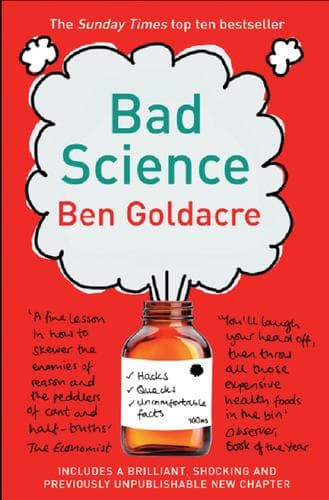
Book details and cover from Google Books.
Ready to read Bad Science?
Get your copy on Amazon, or listen to it on Audible. We earn a commission if you buy through these links.