
We earn a commission if you buy through these links. Learn more
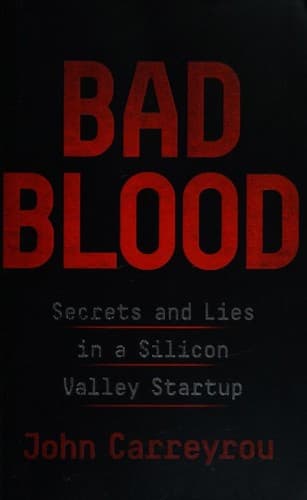
Bad Blood
Guide by the Books of the Day editors · Updated · How we write our guides
A reporter's gripping account of how Theranos sold a blood-testing miracle that did not work, told with the pacing of a thriller.
What Creators Say About Bad Blood
2 creators reviewed Bad Blood on YouTube between 2018 and 2019, with 23.4K views between them. Their opinions are their own; we picked these reviews, we didn't write them.
What It's About
Bad Blood is John Carreyrou's account of Theranos, the Silicon Valley startup that promised to run hundreds of medical tests from a few drops of blood. Carreyrou, a Wall Street Journal reporter, was the one who pulled the company's claims apart, and the book is built on that investigation. It follows the company from its founding by a young Stanford dropout, Elizabeth Holmes, through its rise to a multibillion-dollar valuation and its eventual unraveling.
The approach is narrative reporting rather than analysis. Carreyrou leans on interviews with former employees, insiders, and people who were pressured to keep quiet, and he moves between the company's internal problems and the external pressure it applied to investors, partners, and critics. The result reads more like a suspense novel than a business textbook, with a steady build of small warning signs that the reader sees before the characters in the story do.
The experience is tense and often infuriating. You will not need any background in medicine or finance to follow it. What you take away is less a lesson in how startups work and more a clear picture of how a confident story, backed by powerful people, can hold up for years against evidence that everyone inside seems to have noticed.
Read this if you…
- Are curious about how a high-profile startup could mislead investors and the public for years
- Enjoy investigative reporting that reads like a thriller
- Want a clear, human picture of corporate culture under a charismatic founder
Skip it if you…
- Want a detailed technical explanation of blood testing or diagnostics
- Are looking for a balanced account that gives the company's leaders a full chance to defend their decisions in depth
Key Ideas
- 1
A promise that outran the technology
The central problem Carreyrou documents is a gap between what Theranos said its machines could do and what they actually did. The book shows how that gap was managed through secrecy, selective demonstrations, and carefully staged claims, and why the people closest to the lab found it hard to speak up.
- 2
Charisma as a substitute for proof
Holmes's personal brand, including her black turtlenecks and her deliberately deep voice, helped attract investors, board members, and famous names. Carreyrou argues that this image did real work, letting a company avoid the scrutiny a less compelling founder would have faced.
- 3
Intimidation as a business tool
The book describes how the company used aggressive legal threats and tight confidentiality agreements against employees and outside critics. These tactics kept doubts contained for a long time, and they are a major reason the story is so hard to put down.
- 4
How insiders rationalized what they saw
Many people in the story sensed something was wrong but kept working, often believing the problems were temporary or that the company would soon fix them. Carreyrou's portrait of these choices is one of the book's most useful parts for anyone thinking about their own workplace.
Limitations
The book relies heavily on the testimony of former employees and insiders, many of whom had their own reasons to be critical, so some readers may want more independent documentation. Carreyrou's narrative is organized around people and drama, which means the scientific and technical questions get only light treatment. Holmes and Balwani appear mostly as they are seen by others, and the book was written before the later legal proceedings against them, so its final chapters reflect the story as it stood at publication rather than its full outcome.
Questions Readers Ask
- Who is Bad Blood best suited for?
- It suits readers who like true-crime or investigative stories and want to understand how a business deception worked. You do not need prior knowledge of medicine, finance, or Silicon Valley. It is also useful for people interested in corporate ethics, whistleblowing, or why smart employees sometimes stay silent.
- Is Bad Blood still relevant after the Theranos trial?
- Yes. The book's value lies in its detailed account of how the company operated, which remains instructive regardless of later court outcomes. Some details about legal cases and sentencing have moved on since publication, so it is worth checking recent coverage for the final outcome.
- How does Bad Blood compare to other books about startup failures?
- Compared with more analytical business books, Bad Blood is far more narrative and character-driven. It is closer in feel to a detailed investigative thriller. If you want frameworks for avoiding similar mistakes, you may want to pair it with a more analytical title on corporate governance.
- Published
- 2018
- ISBN
- 9781509868063
- Difficulty
- beginner
- Category
- Business
Book details and cover from Google Books.
Ready to read Bad Blood?
Get your copy on Amazon, or listen to it on Audible. We earn a commission if you buy through these links.