
We earn a commission if you buy through these links. Learn more
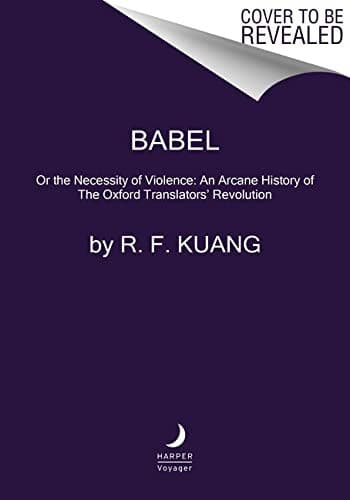
Babel
Guide by the Books of the Day editors · Updated · How we write our guides
A young translator-in-training discovers that Oxford's prestige is built on colonial theft in Kuang's footnoted, fierce alternate-history novel about language and power.
What It's About
Babel follows Robin Swift, a boy taken from Canton as a child and raised in England by the scholar Professor Lovell, who trains him for one purpose: to win a place at Oxford and join its Royal Institute of Translation, known as Babel. In this alternate nineteenth-century Britain, the empire runs on silver bars whose power comes from translation. A skilled translator can carry the meaning of one word into another and bind it into metal, so the gap between languages becomes both a source of magic and a source of profit.
The book is written as a novel with extensive footnotes, a device that adds scholarly commentary, historical asides, and dry irony. Reading it feels partly like working through an annotated academic history, and the footnotes often say as much as the main text. The prose is dense and deliberately ornate in places, while the Oxford scenes move with the tension of a campus drama and a school story.
Reading it is an emotional experience as much as an intellectual one. Kuang takes the coming-of-age story seriously, dealing with friendship, ambition, and the pull of belonging to an institution that will never fully accept you. The book is slow to build, but its arguments about language, loyalty, and empire keep tightening as Robin's education turns into something harder to defend.
Read this if you…
- want historical fiction with a sharp political argument about empire and education
- enjoy coming-of-age stories about ambition, friendship, and divided loyalties
- like puzzles of language and meaning and don't mind footnotes that build a second story
Skip it if you…
- want a fast, plot-driven fantasy with a light magic system and few digressions
- find academic asides and scholarly tone tiring over several hundred pages
Key Ideas
- 1
Translation as a source of power
The novel treats translation as a craft with real consequences. Whoever decides what crosses between languages, and what is lost on the way, holds influence over commerce, knowledge, and politics. Kuang makes this an engine of plot and magic alike, so the reader sees how small linguistic choices can carry large material stakes.
- 2
Empire built on borrowed knowledge
Oxford's brilliance rests on resources and labor drawn from colonized places. Robin admires the institution that trained him, then starts to see how its wealth depends on exploitation. The book asks what it means to serve a system that depends on the people you come from being unheard.
- 3
Belonging and the cost of assimilation
Robin is an outsider who works hard to become an insider. His friendships with other students are warm and complicated, and they show how ambition and loyalty can pull against each other. The novel is strongest when it examines what he gives up to be accepted.
- 4
Footnotes as a second narrative
The annotations do more than explain. They add historical context, undercut characters, and sometimes reframe scenes entirely. Readers who skip them will get the story but miss much of the book's argument and humor.
Limitations
Many readers find the first section slow, since the early chapters spend a lot of time establishing the Institute and its rules. The magic system is explained largely through lectures and demonstrations, which can feel like exposition. The footnotes are a strength for some and an obstacle for others. The novel also makes its political points openly, and some readers feel the argument occasionally outweighs the characters. Its alternate Oxford is a stylized version of history rather than a close reconstruction, so readers looking for historical accuracy should read it as fiction inspired by real events.
Questions Readers Ask
- Is Babel good for readers who don't usually read fantasy?
- Yes, if you are willing to engage with its ideas. The magic is tied closely to the study of language, so it works more like a historical novel with a rule system than a typical epic. Readers who enjoy literary fiction about school, class, and empire will often find it easier to enter than traditional fantasy.
- How does Babel compare to The Secret History?
- Both books feature elite students at a prestigious university and a slow reveal of what their privileged world costs. Babel is more overtly political and historical, and it uses footnotes to add commentary. The Secret History is more psychological and focused on a small circle of friends, so readers who liked one may enjoy the other for different reasons.
- Published
- 2022
- ISBN
- 9780008501815
- Difficulty
- intermediate
- Category
- Fiction
Book details and cover from Google Books.
Ready to read Babel?
Get your copy on Amazon, or listen to it on Audible. We earn a commission if you buy through these links.