
We earn a commission if you buy through these links. Learn more
Babel-17
Babel-17 turns a language puzzle into a fast space adventure, and its poet-heroine's sharp, unusual mind makes it a classic worth reading for ideas as much as action.
What It's About
Babel-17 is a short science fiction novel from 1966 that reads like a space adventure but keeps asking a more unusual question: how much of what we can think depends on the language we think in? The story centers on Rydra Wong, a poet and linguist who is pulled into a military problem. An unknown code is spreading through the Alliance's communications and seems to be causing real damage, and she is asked to crack it. The plot moves briskly through ships, crews, and remote outposts, so the book never feels like a lecture, even when it is thinking hard.
Delany writes in a compressed, lyrical style. Sentences are often dense with imagery, and the narration takes its cues from Rydra's habit of noticing patterns in speech and in the world around her. Some readers find the early chapters abrupt, since the book trusts you to keep up with its vocabulary and its shifting loyalties. The tone is adventurous and playful, but there is a steady undercurrent of melancholy and sharp observation about power and belonging.
Reading it is less like watching a film and more like working through a puzzle while someone tells you a good story. You will finish it feeling that you have been shown a new way of looking at communication, and you may want to go back and reread the middle sections with fresh attention.
Read this if you…
- enjoy science fiction that treats language as a central puzzle rather than a background detail
- like compact, lyrical prose and don't mind working out meaning as you go
- are curious about the 1960s science fiction that influenced later writers of genre-bending novels
Skip it if you…
- want a straightforward plot with clear explanations and a steady pace throughout
- prefer hard science fiction with detailed technology and realistic physics
Key Ideas
- 1
Language as a shaper of perception
The novel's central argument is that the words a person has access to affect what that person can notice and reason about. Delany dramatizes this idea rather than explaining it, so the reader sees how a sharper vocabulary changes the way a character reads a situation. It is an early, vivid treatment of a question that later linguists and writers would argue about in more technical terms.
- 2
Poetry as a form of intelligence
Rydra is a poet first, and the book treats her training in close reading, metaphor, and pattern-finding as a practical skill. Her methods look like poetic analysis but produce results like code-breaking. Readers who think of poetry as decorative will find the book quietly arguing that attention to language is one of the most useful forms of thinking available.
- 3
Communication, misunderstanding, and power
Throughout the book, the gap between what is said and what is understood becomes a source of both danger and opportunity. Military and political institutions depend on controlling information, and the story asks who gets to define meaning when languages collide. The themes feel relevant to any reader who has watched a message get distorted on its way through an organization.
- 4
A space opera that is also an experiment
Babel-17 uses the conventions of planetary adventure, starships, and crews, but it bends them toward formal ambition. The structure and prose are more fragmented than typical genre fare of the period. This mix of pulp energy and literary experiment is the main reason the book is still discussed among readers who do not usually read science fiction.
Limitations
Babel-17 is a product of its era, and some of its attitudes, gender roles, and assumptions about the future feel dated to modern readers. The prose is dense and sometimes elliptical, which can frustrate readers who want a clear sense of who is doing what and why. Characterization is more about function and idea than psychological depth, so people who value rich inner lives may find the figures thin. The book also leaves some of its questions open, which some readers will appreciate and others will find unsatisfying.
Questions Readers Ask
- Is Babel-17 a good first Samuel R. Delany novel?
- It can be, because it is shorter and more focused than many of his longer works. It gives you a clear sense of his interest in language and his musical sentence rhythms without the sprawl of some later books. Readers who want to go deeper afterward can move on to his more ambitious novels with a good sense of what he is doing.
- How does Babel-17 compare to Ursula K. Le Guin's science fiction about language?
- Both books take language seriously as a theme, but they approach it differently. Le Guin tends toward calm, anthropological reflection, while Delany is more restless, using quick pacing and dense imagery. If you enjoyed the ideas in Le Guin's work but want something more kinetic and experimental, Babel-17 is a good match.
- Is Babel-17 still worth reading today?
- Yes, especially if you are interested in how language shapes thought or in the history of experimental science fiction. Some of the social assumptions feel old, but the central questions about meaning, translation, and information control remain current. Expect to read slowly and be willing to reread passages.
- Published
- 1966
- ISBN
- 9780575094208
- Difficulty
- intermediate
- Category
- Fiction
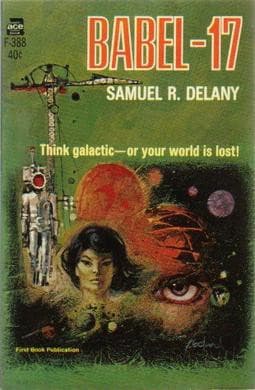
Book details and cover from Google Books.
Ready to read Babel-17?
Get your copy on Amazon, or listen to it on Audible. We earn a commission if you buy through these links.