
We earn a commission if you buy through these links. Learn more
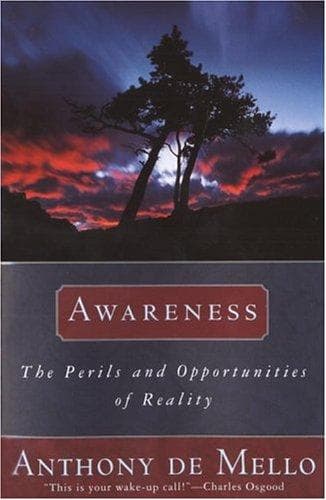
Awareness
A short, provocative set of talks and exercises that asks you to notice how much of your thinking, wanting, and reacting runs on autopilot.
What It's About
Awareness is a collection of talks and guided exercises by Anthony de Mello, a Jesuit priest who spent much of his life teaching meditation and spiritual practice. It was assembled from his talks after his death in 1987, and it reads less like a single argument than a series of nudges, each aimed at getting you to notice something you have been doing without thinking.
The method is simple to describe and hard to practice. De Mello keeps returning to one claim: much of what we call feeling, wanting, and deciding is conditioning, and we mostly stay asleep to it. He uses short stories, jokes, and sharp questions rather than long reasoning, and he often ends a point with a small experiment you can run during an ordinary day, such as watching your reaction to a familiar irritation without trying to change it.
Reading it feels more like sitting in on a teacher's sessions than working through a textbook. Sections are short enough to read in a few minutes, and the tone is blunt, sometimes teasing, with little patience for comfortable beliefs, including religious ones. You will likely finish with a list of habits you want to test rather than a system to adopt, and that is largely the point.
Read this if you…
- want a short, practical way into mindfulness and self-examination
- are comfortable with spiritual language but suspicious of dogma
- like teachers who use stories and humor to make a point
Skip it if you…
- want a step-by-step program with measurable results
- need a book grounded in clinical research or formal therapy techniques
Key Ideas
- 1
Living asleep to your own conditioning
De Mello's central claim is that most people move through life on autopilot, reacting according to habits picked up from family, culture, and fear. He treats this sleep not as a moral failing but as the default state, and argues that the first step toward freedom is simply seeing it happen. The book repeatedly asks you to catch yourself in a reaction before you rationalize it.
- 2
Happiness as something you stop chasing
A recurring thread is that happiness is not produced by getting what you want. De Mello argues that the pursuit of security, approval, and possessions keeps us anxious, and that a quieter state appears when that pursuit loosens. Readers who expect techniques for getting ahead will find this uncomfortable, since the book questions the goals themselves rather than offering better ways to reach them.
- 3
Observation as practice, not theory
Much of the material is built around exercises: attending to sounds, body sensations, and your own thought patterns without labeling them. The point is direct experience. De Mello is skeptical of ideas you agree with only intellectually, and he often pushes you back toward what you can notice right now in your body and mind.
- 4
Distrust of borrowed beliefs and authority
De Mello is harsh on religious routine, gurus, and inherited doctrine when they replace personal seeing. He frames faith as attention and honesty rather than adherence to rules, which makes the book feel at home for spiritual readers and also for skeptics who dislike dogma. Expect him to poke at your own certainties too.
Limitations
The book is a compilation, so its structure is loose and repetitive. The same points return in different wrappers, which some readers find refreshing and others find tedious. Because the talks were not written as one continuous argument, it can be hard to see how one idea depends on another. De Mello offers little empirical support for his claims, and his sharp tone can read as dismissive toward readers who find meaning in traditional religion or in therapy. The exercises also assume a willingness to sit with discomfort that not everyone wants.
Questions Readers Ask
- Is Awareness still relevant today?
- Largely yes. The core questions about habit, attention, and whether you are driven by your own choices are timeless, and the book reads as fresh to people new to mindfulness. Some stylistic choices and references feel dated, and the religious framing will matter more to some readers than others.
- How does it compare to Wherever You Go, There You Are?
- Jon Kabat-Zinn's book is more structured and secular, offering a clear case for meditation as a daily practice. De Mello is more provocative and less systematic, using parables and sharp questions to challenge how you see yourself. If you want a manual, choose Kabat-Zinn; if you want to be jolted out of comfortable assumptions, De Mello is the better bet.
- Published
- 1990
- ISBN
- 9780385249362
- Difficulty
- beginner
- Category
- Psychology
Book details and cover from Google Books.
Ready to read Awareness?
Get your copy on Amazon, or listen to it on Audible. We earn a commission if you buy through these links.