
We earn a commission if you buy through these links. Learn more
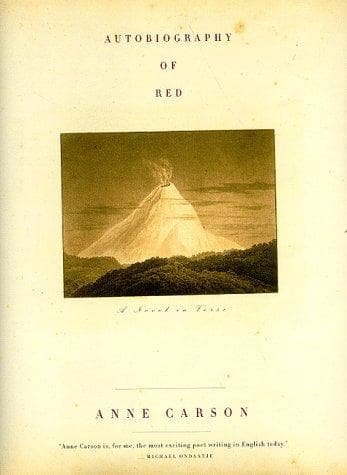
Autobiography of red
by Anne Carson, Vanasay Khamphommala
A modern reworking of the Geryon myth as a novel in verse, where desire, language, and identity are pulled apart and reassembled with unusual precision and wit.
What It's About
Autobiography of Red is Anne Carson's 1998 novel in verse, built on the ancient story of Geryon, the winged red monster of Greek myth who is defeated by Herakles. Carson turns that old frame into an intimate, present-tense account of a boy who is different from everyone around him, and of a love that arrives suddenly and changes him. The narrative moves through memory, scene, and interior argument, so it reads less like a plot being delivered than like a mind working through its own history.
The style is spare, startling, and often very funny. Carson uses short, clipped lines, sudden shifts in register, and images that feel both classical and contemporary, and she is comfortable letting a sentence trail into silence. Scholarly reference and everyday speech sit side by side. The book also includes visual elements that break up the text and add to its sense of a made object rather than a conventional story.
Reading it is an active, sometimes disorienting experience. You will spend more time with individual images and turns of phrase than you would with a typical novel, and the emotional force tends to build slowly and then land hard. It rewards rereading and slow reading, and it suits anyone who enjoys poetry that tells a story while questioning what storytelling is for.
Read this if you…
- enjoy poetry that tells a story and does not mind working for meaning
- are drawn to reimagined Greek myth and the way old material can feel new
- like emotionally intense books written in a sharp, unconventional voice
Skip it if you…
- want a conventional plot with steady pacing and clear scene-by-scene progress
- find fragmented, elliptical writing frustrating rather than engaging
Key Ideas
- 1
Myth reimagined as a private, modern life
Carson takes a minor, grotesque figure from ancient myth and gives him an inner life. The old story becomes a lens for thinking about how a person who is 'other' is seen, named, and treated by the world, rather than a backdrop of heroic deeds.
- 2
Desire as a force that rearranges the self
Love in this book is not a cozy theme but a disruption. The narrator's attachment to another person reshapes how he understands his body, his past, and his sense of who he is, and the book tracks that change with unsentimental attention.
- 3
Verse as a tool for storytelling
The line breaks, pauses, and compressed phrasing do real narrative work. Carson shows how poetry can carry plot, argument, and emotion at once, and how a novel can be built from fragments without losing momentum.
- 4
Language, translation, and the gaps in old texts
The book is preoccupied with what survives from the past and what is lost or distorted in transmission. Carson plays with fragmentary sources and open spaces, making the reader aware of how much of any story is reconstruction.
- 5
Identity and the wounds of difference
Being unlike others, in appearance and in feeling, is a recurring concern. The book treats this with tenderness and irony, avoiding easy messages about acceptance and instead showing how loneliness and self-definition shape each other.
Limitations
Some readers find the fragmentary structure and deliberate gaps frustrating, especially if they expect a traditional novel. The book's references to classical scholarship and mythic sources can feel dense without some background, and a few readers find its wit cool or its emotional register withheld. Its formal experiments, while still striking, may read as more familiar now than they did when it first appeared, since many contemporary writers have adopted similar verse-and-fragment techniques.
Questions Readers Ask
- Do I need to know Greek myth to read Autobiography of Red?
- No, but some familiarity helps. The book is built on the story of Geryon and Herakles, and knowing the basic myth lets you notice what Carson changes. Readers without that background can still follow the emotional arc and the intensity of the language.
- Is Autobiography of Red a novel or a poetry collection?
- It is a novel in verse, which means it tells a continuous story but uses poetic form throughout. Readers who enjoy poetry will find it accessible, and readers who prefer prose may find the line-by-line rhythm a useful way into the story.
- Published
- 1998
- ISBN
- 9780224059732
- Difficulty
- intermediate
- Category
- Adaptations
Book details and cover from Google Books.
Ready to read Autobiography of red?
Get your copy on Amazon, or listen to it on Audible. We earn a commission if you buy through these links.