
We earn a commission if you buy through these links. Learn more
Auschwitz
Guide by the Books of the Day editors · Updated · How we write our guides
A careful, testimony-driven account of how Auschwitz grew from a Polish prison camp into the Nazis' largest killing site, told partly through the words of those who ran it.
What Creators Say About Auschwitz
2 creators reviewed Auschwitz on YouTube between 2024 and 2025, with 2.5M views between them. Their opinions are their own; we picked these reviews, we didn't write them.
What It's About
Laurence Rees, a BBC documentary maker, wrote this book to accompany his television series, and it reads like it: a chronological history built from archival documents, camp records, and long interviews. Rees begins with the camp's origins in 1940 and follows its expansion into a complex of sites, including Birkenau, built for mass murder, and the factory and labour operations around it. The book's spine is the decision-making and daily routine that made the killing possible.
What sets it apart is the testimony. Rees interviewed survivors and also former members of the SS and camp staff, and he sets their accounts beside the documents and against each other. The result is less a sweeping thesis than a close view of how an industrial killing process was organised, and of how ordinary men and women adapted to it. Some passages are hard to read, and the book does not look away from the grim mechanics.
The experience is sober and cumulative rather than lyrical. Rees keeps his own voice restrained, so the force comes from the evidence and the people speaking. Expect a dense, emotionally heavy read, one that raises more questions about complicity and self-justification than it answers neatly.
Read this if you…
- want a detailed, evidence-based history of how the Holocaust was carried out at one site
- are ready to hear perpetrators describe their own roles in their own words
- watched the BBC series and want the fuller account behind it
Skip it if you…
- want a memoir or a survivor's personal story rather than a wide historical account
- need a gentle introduction to the Holocaust, since this is detailed and often graphic
Key Ideas
- 1
A camp that changed its purpose
Auschwitz began as a camp for Polish political prisoners and only gradually became the centre of the murder of European Jews. Rees traces that shift and shows how policy was shaped on the ground, not only in Berlin, which makes the site's history feel less fixed than it is often presented.
- 2
Perpetrators describing their own roles
Rees gives former SS men and staff room to explain their jobs in their own words. Their accounts reveal how people rationalised what they did, and how their memories sit uneasily with the documentary record. Reading them alongside the paperwork is one of the book's most useful exercises.
- 3
Mass murder as administration
The book shows the logistics behind the killing: train timetables, selection procedures, record-keeping, and the camp economy that used forced labour for industrial firms. The emphasis on routine and paperwork makes clear that the atrocity depended on ordinary bureaucratic habits.
- 4
Prisoners who survived and resisted
Survivor testimony keeps the victims at the centre, including the prisoners forced into the Sonderkommando and the 1944 uprising. Rees shows how people struggled to survive from day to day, and how a few tried to resist, which balances the focus on the perpetrators.
Limitations
Perpetrator testimony is self-serving and often selective. Rees is generally careful to flag this, but some readers will feel the book leans on those voices too heavily. Because it grew from a television series, its structure is more narrative than analytical, and it gives less space to historiographical debate than specialist academic studies do. Scholarship since its publication has refined estimates and details, so treat it as a strong popular history rather than the last word.
Questions Readers Ask
- Is Auschwitz by Laurence Rees a good first book on the Holocaust?
- It can be, but it is probably better as a second book. It assumes you already know the broad outline of the Holocaust and moves through dense detail on camp administration and deportations. Readers new to the subject might start with a shorter overview and then come to Rees for the perpetrators' perspective.
- How does it compare with Primo Levi's If This Is a Man?
- They are very different. Levi's book is a survivor's first-person memoir of his time in the camp system, written with a sharp literary eye. Rees writes a wider historical account that draws on many voices, including perpetrators, and covers the site's whole history. Read Levi for the inner experience of prisoners and Rees for the structure of the operation.
- Published
- 2005
- ISBN
- 9780563522966
- Difficulty
- intermediate
- Category
- History
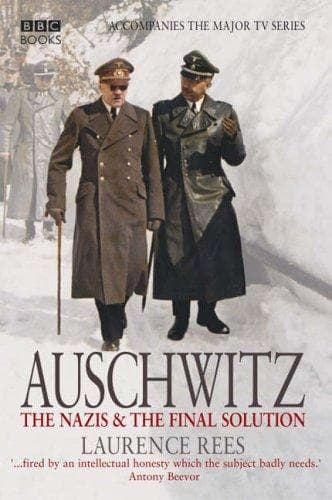
Book details and cover from Google Books.
Ready to read Auschwitz?
Get your copy on Amazon, or listen to it on Audible. We earn a commission if you buy through these links.