
We earn a commission if you buy through these links. Learn more
Aurora
Kim Stanley Robinson's Aurora asks what it really takes to keep a human society alive on a starship, and refuses the easy triumph most interstellar fiction promises.
What It's About
Aurora follows a generation starship, the Argo, carrying a crew of descendants of people who left Earth long before any of them were born. Its destination is Aurora, a moon orbiting Tau Ceti, a star about twelve light years away. The people aboard have never seen Earth, and the ship is their entire world, so every decision about water, air, food, and each other carries real weight.
The story is narrated by Devi, the ship's artificial intelligence, who speaks in a measured, curious voice and tries to make sense of human behavior and the ship's systems. That framing gives the book its distinctive texture: the reader sees the crew from inside their daily routines and from a mind that understands the machinery better than they do. Robinson moves slowly, lingering on maintenance, schooling, and ecology rather than spectacle.
Reading it is a patient, sometimes demanding experience. Much of the pleasure lies in the accumulation of small details and in arguments about what a closed world owes its members. It is less a space adventure than a long meditation on what it takes to keep a society functioning, and it deliberately resists the triumphant payoff many readers expect from the genre.
Read this if you…
- want hard science fiction that treats engineering and ecology as the real drama
- enjoy slow, reflective novels that dwell on how societies work
- are curious about what a generation starship would actually be like to live in
Skip it if you…
- want a fast plot with action set pieces and a clear sense of forward momentum
- prefer characters with strong individual arcs over ideas and systems
Key Ideas
- 1
A ship is a fragile, closed ecosystem
The Argo works as a miniature biosphere in which water, air, soil, and waste must cycle endlessly. Robinson makes the reader feel how little slack exists, and how a small failure can spread through every part of life aboard. Nothing is disposable, and the book treats maintenance as a moral and practical concern.
- 2
Inheriting a mission you never chose
The crew members were born into a voyage they did not design or agree to. The novel explores the tension between duty to ancestors and mission, and the personal freedom each generation wants. Questions of obligation, loyalty, and what one owes the future run through nearly every chapter.
- 3
An AI narrator with an outsider's eye
Devi's perspective gives the book its particular tone. The narrator is curious, careful, and sometimes limited in what it can grasp about human emotion and politics. This gives the reader a view that is both intimate and slightly removed, which sharpens the sense of how strange the crew's situation really is.
- 4
Politics in a place with no exit
Scarcity, authority, and disagreement play out in a community that cannot simply leave or start over. Robinson examines how rules form, how they get challenged, and how fairness is negotiated when every resource is counted. The small scale makes the political questions feel unusually concrete.
- 5
Skepticism about escaping to another world
Aurora questions the popular idea that colonizing another planet is a clean solution to Earth's problems. The book treats the dream of a new home with suspicion, asking what is lost, what is assumed, and whether humans can carry their habits and failures into a new place.
Limitations
The pace is deliberately slow, and long passages of discussion, technical explanation, and institutional detail can feel repetitive or static to readers used to tighter storytelling. Some critics find the human characters less vivid than the ideas they embody, and a few may feel that the book's arguments are stated more often than dramatized. Readers who expect a satisfying, triumphant arc may find the book's stance frustrating rather than rewarding. The science is generally careful, but some passages will feel dense to non-specialists.
Questions Readers Ask
- Is Aurora a good first Kim Stanley Robinson novel?
- It can be, but it is more demanding than some of his earlier and more accessible work. Readers new to his writing may find the slow pace and dense systems thinking tough going. If you enjoy big ideas and are patient with long, reflective passages, it works well as an introduction to his style and concerns.
- How does Aurora compare to other generation ship novels?
- Many generation ship stories focus on the arrival and the wonder of a new world. Aurora is more interested in the daily life, politics, and ecological strain of the voyage itself, and it is noticeably more skeptical about the destination. Readers who liked the sense of realism in books about closed societies will likely appreciate its approach.
- Is Aurora still relevant today?
- Yes. Its concerns about closed ecosystems, sustainability, and the limits of technological escape feel even more pointed now. The book is less about future gadgets than about how human communities survive and govern themselves, which keeps its questions current regardless of how the technology around them changes.
- Published
- 2015
- ISBN
- 9780316098090
- Difficulty
- intermediate
- Category
- Fiction
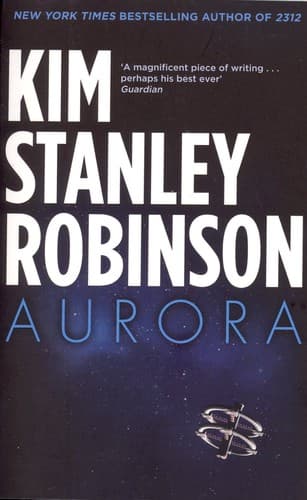
Book details and cover from Google Books.
Ready to read Aurora?
Get your copy on Amazon, or listen to it on Audible. We earn a commission if you buy through these links.