
We earn a commission if you buy through these links. Learn more
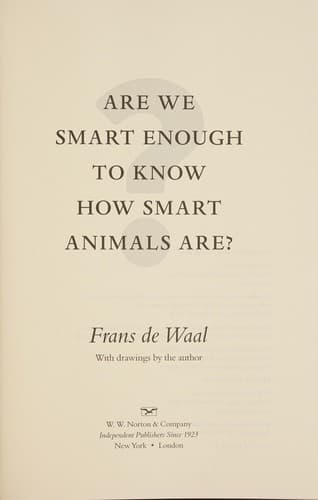
Are We Smart Enough to Know How Smart Animals Are?
A primatologist's sharp case that scientists have been too stingy crediting animals with minds, and that fear of anthropomorphism has made us wrong the other way.
What It's About
The book's central complaint is that science has been too reluctant to credit animals with minds. Frans de Waal calls this habit anthropodenial, the refusal to attribute to animals capacities they plainly show, and he argues it is the mirror image of the anthropomorphism scientists fear. Because he is a primatologist who has spent decades watching chimpanzees and bonobos, most of his examples come from primates, though he also ranges across elephants, dogs, birds, and octopuses.
The approach is informal and argumentative rather than a survey of the literature. He builds his case from observed behavior: animals solving problems, comforting one another after conflict, cooperating, and reacting to unfair treatment. The tone is combative toward older experimental habits and warm toward the animals themselves, and the case is cumulative, so each example adds weight to the next.
Reading it feels like listening to an experienced scientist who is comfortable saying 'I think' and who expects to be argued with. The ideas do not require a technical background, and the chapters are easy to dip into. Some readers will find the repetition wearing, while others will find the argument hard to dismiss.
Read this if you…
- want a well-argued challenge to how science thinks about animal minds
- are curious about primate behavior and what it suggests about empathy and fairness
- enjoy a confident, opinionated author who makes a case rather than surveying one
Skip it if you…
- want a neutral, comprehensive overview of animal cognition research
- need rigorous experimental detail and clearly separated evidence from interpretation
Key Ideas
- 1
Anthropodenial versus anthropomorphism
de Waal argues that researchers have been so afraid of projecting human traits onto animals that they routinely deny evident abilities. He treats this overcorrection as an error of its own, not a safe default, and asks readers to weigh both kinds of mistake honestly.
- 2
Misreading the principle of parsimony
A classic rule says to prefer the simplest explanation for animal behavior. de Waal contends that the rule has often been used to dismiss complex explanations without testing them, so that simple-sounding conclusions end up favored by default rather than by evidence.
- 3
Against the ladder of intelligence
He challenges the idea that species can be ranked on a single scale with humans at the top. Abilities, he suggests, are specialized and vary by species and by ecological need, so a crow, an octopus, and a chimpanzee may each excel at different things.
- 4
Empathy, consolation, and fairness in animals
The book's most vivid material concerns animals that console distressed companions, cooperate, and respond to unequal treatment. de Waal uses these observations to argue that the roots of moral-seeming behavior are older than humanity and not uniquely ours.
Limitations
Much of the evidence is anecdotal or drawn from observation rather than controlled experiments, and some critics say de Waal can be selective in the cases he chooses. The book leans heavily on primates, so its picture of other species is thinner. He also takes sharp aim at behaviorist traditions, and some readers will find that polemical. Research on octopuses, corvids, and other species has moved quickly since publication, so the book is best read as a framing argument rather than a current summary of the field.
Questions Readers Ask
- Is this book still relevant to animal cognition research?
- Yes, mainly as a framing argument. The core claim, that scientists should avoid both overattributing and underattributing minds to animals, remains widely discussed. The specific studies and examples are dated in places, so readers who want the current state of the field should pair it with more recent reviews.
- How does it compare to Peter Godfrey-Smith's Other Minds?
- Godfrey-Smith's book is more philosophical and more focused on octopuses and the question of consciousness. de Waal's is more practical and primate-centered, with a stronger sense of urgency about how scientists should interpret what they observe. Readers interested in the mind itself may prefer Godfrey-Smith, while readers who want a case about research habits may prefer de Waal.
- Published
- 2016
- ISBN
- 9780393246193
- Difficulty
- beginner
- Category
- Psychology
Book details and cover from Google Books.
Ready to read Are We Smart Enough to Know How Smart Animals Are??
Get your copy on Amazon, or listen to it on Audible. We earn a commission if you buy through these links.