
We earn a commission if you buy through these links. Learn more
Animalia
by Graeme Base
A dense, witty alphabet picture book whose crowded painted pages reward slow looking, so adults often linger over it as much as the children they read it to.
What It's About
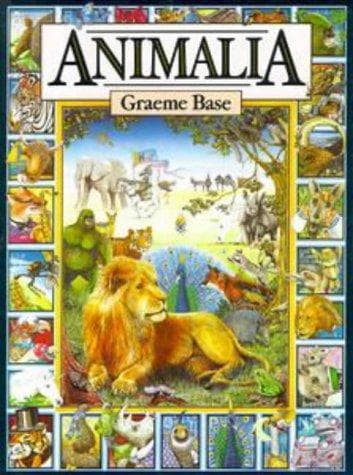
Animalia is a picture book alphabet by Graeme Base, first published in 1986. Each letter gets its own full-page painting, packed with animals, objects, and small scenes built around words that begin with that letter. The text is short and rhythmic, and it is delivered as a series of alliterative sentences rather than a narrative. Nothing much happens from page to page in the usual storytelling sense, so the book is better understood as a catalogue of images to explore than as a plot to follow.
The real draw is the illustration. Base paints in a detailed, almost old-master style, and every spread hides more than the eye first catches. A recurring mouse appears throughout, and the pictures reward readers who go back to find the smaller jokes, clustered objects, and quiet details tucked into corners. Children often enjoy the search itself, while adults notice the craft and the playful invention in each scene.
Reading it is a slow, sociable experience. It works best read aloud, with a child pointing at things, and it can stretch into a long session when a reader wants to hunt through a single page. It is less a book you finish in one sitting than one you return to, discovering something new each time.
Read this if you…
- want a picture book that works for a mixed-age read-aloud
- enjoy hunting for small details in busy illustrations
- are helping a young child learn letters, sounds, or new vocabulary
Skip it if you…
- want a story with characters, a plot, or a satisfying ending
- prefer quick reads and would find lingering over each page tiresome
Key Ideas
- 1
The alphabet as a container for abundance
Base uses the alphabet as a frame for an enormous amount of visual material. Each letter becomes an excuse to fill a page with animals and objects, so the structure stays simple while the pictures grow richer. The book shows how a familiar format can hold far more than it usually does.
- 2
Hidden detail as the real story
Because there is no conventional plot, the pleasure comes from searching. Small creatures, repeated motifs, and background jokes give each spread a second layer. Readers who slow down find that the book is really about attention, and that looking carefully is its own reward.
- 3
Alliteration and playful language
The sentences lean on sound, with repeated initial letters that make the words fun to say aloud. This gives young children a gentle introduction to letter sounds and vocabulary. The language is deliberately light, so it never competes with the images for the reader's attention.
- 4
Realistic painting with a light touch
The artwork is carefully rendered, giving the animals a convincing presence, but the mood stays playful rather than scientific. That mix of precision and whimsy is a large part of why the book appeals to adults who might otherwise dismiss a picture book as too simple.
Limitations
The book is built around the alphabet, so its vocabulary and sentence structure are fixed by that format. Some readers find the text thin once the hunt is done, and the sentences can feel more like labels than language. Adults who want narrative depth or emotional arc will not find it here. Its visual style is also very particular, and not every reader will connect with the dense, formal painting. Its recognition of animals and objects is broad rather than focused on any one subject.
Questions Readers Ask
- Is Animalia suitable for adults or only young children?
- It is written for young children, but many adults enjoy it. The text is simple, while the illustrations are dense enough to keep a grown reader searching for a long time. It works well as a shared book, where a child and adult each notice different things on the same page.
- Is Animalia still worth reading today?
- Yes, for the illustrations and the playful approach to the alphabet. The format is traditional, so it does not feel dated in its core idea. Its appeal rests on careful drawing and hidden detail rather than on any trend, which helps it hold up across decades.
- How does Animalia compare to a standard alphabet book?
- A standard alphabet book usually gives one labelled picture per letter. Animalia packs many images into each page and rewards careful looking. If you want a simple first-words book, a typical alphabet book may suit better. If you want something to study and revisit, Animalia offers more.
- Published
- 1986
- ISBN
- 9780590440868
- Difficulty
- beginner
- Category
- Fiction
Book details and cover from Google Books.
Ready to read Animalia?
Get your copy on Amazon, or listen to it on Audible. We earn a commission if you buy through these links.