
We earn a commission if you buy through these links. Learn more
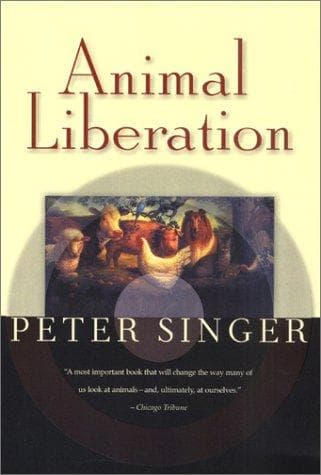
Animal Liberation
by Peter Singer
The founding text of modern animal ethics: a clear, argument-driven case that animal suffering counts morally and that our treatment of farmed and lab animals is hard to defend.
What It's About
Animal Liberation, first published in 1975, is the book that gave the modern animal welfare and animal rights debate much of its vocabulary. Peter Singer, a philosopher working in the utilitarian tradition, does not start from sentiment or from a claim about animal rights. He starts from a principle he thinks most people already accept: that the capacity to suffer is what makes a being's interests matter, and that similar interests deserve similar weight regardless of species. From there he tests common practices against that standard.
The result is an argument rather than a manifesto. Singer describes what happens in industrial farming and in laboratories, draws on the research and reports available at the time, and then asks readers to justify what they see. The tone is measured and often dry, with long stretches of careful reasoning and a willingness to answer objections. Some of the descriptions are grim, but the book is rarely shrill.
Expect a book that changes how you weigh arguments more than one that hands you a finished lifestyle. Singer makes a case for vegetarianism and for reducing harm in research, but the core of the book is the reasoning behind those conclusions, which you can accept or contest on its own terms. Reading it is closer to sitting in on a seminar than to consuming a campaign pamphlet.
Read this if you…
- want a rigorous, argument-first case for rethinking how you treat animals
- are willing to examine your own diet and assumptions rather than just read about them
- are interested in the philosophical foundations of modern animal welfare debates
Skip it if you…
- are looking for a practical guide to vegan cooking or a lifestyle manual
- want up-to-date data on current farming and research conditions, since the factual sections are dated
Key Ideas
- 1
Equal consideration of interests
Singer argues that the morally relevant question is whether a being can suffer or have experiences that matter to it, and that comparable interests should count equally whatever the species. He presents this as an extension of the principle behind human equality, not as a claim that animals are the same as people in every respect.
- 2
Speciesism as an unjustified bias
Singer uses the term speciesism for giving weight to a being's species membership rather than to its interests, drawing an analogy to racism and sexism. He argues that the analogy exposes how often humans set animal suffering aside for reasons no one would accept if applied to people.
- 3
Factory farming as the largest-scale harm
The book's most sustained argument concerns intensive farming, where animals are confined and handled in ways that prioritize output. Singer contends that because so many animals are involved, and because the gains are mostly convenience and taste, the case against eating them is strongest here.
- 4
Testing and research under the same scrutiny
Singer examines animal experimentation, including product safety tests and medical and psychological research, and asks whether the benefits really justify the suffering inflicted. He is more open to some research than many readers expect, insisting only that the weighing be honest rather than assumed.
Limitations
Much of the factual material reflects conditions and studies from the 1970s and has been superseded, though later editions updated some of it. Singer's utilitarian framework is contested; critics argue it struggles with rights, with the intrinsic value of life, and with how to compare interests across very different kinds of minds. The book focuses mainly on farming and experiments rather than on wild animals, fishing, or law and policy, so it reads as a foundational argument rather than a complete account of the field.
Questions Readers Ask
- Is Animal Liberation still relevant today?
- Yes, mainly as a foundational text. Its central argument about equal consideration of interests remains a reference point for much of animal ethics, and many later debates start from it. The specific descriptions of farming and research are dated, so pair it with current reporting and more recent scholarship to see how conditions and evidence have changed since it first appeared.
- How does it compare to Tom Regan's The Case for Animal Rights?
- Singer argues from consequences and interests, measuring suffering and treating comparable interests equally. Regan, in The Case for Animal Rights, rests his case on the idea that certain individuals have inherent value and rights that cannot be overridden by aggregate benefits. Readers who find utilitarian reasoning convincing will likely prefer Singer; those who think some lines should never be crossed may find Regan more satisfying.
- Do I need a philosophy background to read it?
- No. Singer writes plainly and avoids heavy jargon, and the book is built around concrete descriptions and clear arguments. Some sections are more demanding when he responds to objections, but a general reader willing to follow an argument step by step will manage it comfortably.
- Published
- 1976
- ISBN
- 9780061711305
- Difficulty
- intermediate
- Category
- Vegetarianism
Book details and cover from Google Books.
Ready to read Animal Liberation?
Get your copy on Amazon, or listen to it on Audible. We earn a commission if you buy through these links.