
We earn a commission if you buy through these links. Learn more
Angle of repose
Guide by the Books of the Day editors · Updated · How we write our guides
A crippled, retired historian reconstructs his grandmother's frontier life from her letters, and the result is a meditation on marriage, ambition, and what a family owes its past.
What Creators Say About Angle of repose
2 creators reviewed Angle of repose on YouTube between 2021 and 2022, with 4.9K views between them. Their opinions are their own; we picked these reviews, we didn't write them.
What It's About
Angle of Repose is narrated by Lyman Ward, a retired historian living in a house in Grass Valley, California, in the 1970s. Confined to a wheelchair by illness and facing the breakdown of his own marriage, he decides to write a history of his grandparents, Oliver and Susan Ward. Much of the material comes from Susan's letters and papers, which he reads closely and quotes from, so the novel moves between his present-day life and the lives of the Wards as they move across the nineteenth-century American West, from the East Coast to mining camps, irrigation projects, and far-off outposts.
Stegner builds the book on the tension between two kinds of truth. Lyman is a professional who wants documented facts, while Susan's correspondence is emotional, observant, and often at odds with the official story. The result is a layered portrait in which the reader sees the same events through two sets of eyes, and Lyman's own judgments are open to question. The prose is measured and descriptive, especially in its landscapes.
Reading it feels less like following a plot than like sitting with an older man as he thinks aloud, sorting evidence and admitting what he cannot know. It rewards patience and rereading, and it is often most powerful in its quiet passages about work, disappointment, and endurance.
Read this if you…
- Enjoy slow, reflective novels where the narrator's thinking is as important as the events
- Are interested in Western American history and the realities behind the pioneer myth
- Like books that examine how we judge people from letters, records, and other incomplete evidence
Skip it if you…
- Want a fast-moving plot or a clear narrative drive from start to finish
- Prefer modern, spare prose and find long, formal sentences tiring
Key Ideas
- 1
A historian's honest limits
Lyman's project forces him to confront how much a biography can actually know. The novel repeatedly shows gaps between documents and experience, and asks whether a tidy narrative of someone's life is ever fair to them. This questioning gives the book its intellectual spine and makes it more than a family saga.
- 2
Two voices, one marriage
Stegner sets Lyman's dry, retrospective account against Susan's letters, which are lively and sometimes sharply critical. The contrast lets readers judge the same marriage from inside and outside. It is one of the book's most distinctive techniques, and it turns reading into an act of interpretation.
- 3
The cost of the frontier dream
The Wards follow the promise of the West through engineering projects and boomtowns, and the novel is clear-eyed about the labor, hardship, and broken expectations that come with them. Stegner treats the myth of pioneer progress with respect but without romance, which makes the historical setting feel lived-in rather than decorative.
- 4
Aging, illness, and inheritance
Lyman's physical limits mirror his sense that the energies of earlier generations are fading. The present-day sections explore how people carry forward the stories and failures of their parents. These passages give the historical material emotional weight and connect the two timelines.
Limitations
The novel is long and often slow, and some readers find Lyman's voice stiff or self-pitying, especially in its early chapters. Its portrait of gender and class reflects the attitudes of its period, and some critics have questioned how fully the novel gives Susan her own perspective, since her voice is mediated through Lyman's selection and framing. Stegner's style is deliberately old-fashioned, which can feel distancing to readers used to contemporary fiction.
Questions Readers Ask
- Is Angle of Repose based on a real person?
- Yes, in part. Stegner drew heavily on the life and letters of the illustrator and writer Mary Hallock Foote, and he later edited a collection of her letters. The novel's characters and events are fictional, but the source material gave it a grounded texture of real Western life.
- How does it compare to Stegner's other famous novel, Crossing to Safety?
- Angle of Repose is broader in scope and more historical, covering decades of Western expansion. Crossing to Safety is smaller and more intimate, focused on a long friendship between two couples. Readers who want the epic sweep and the layered historical voice should start with Angle of Repose.
- Published
- 1971
- ISBN
- 9780449209882
- Difficulty
- intermediate
- Category
- Fiction
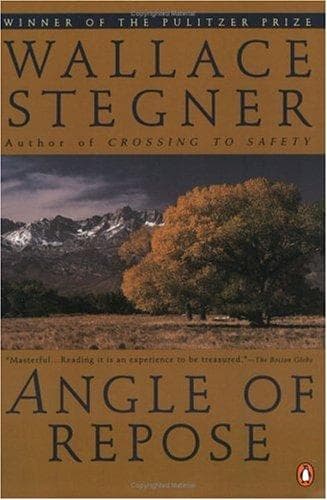
Book details and cover from Google Books.
Ready to read Angle of repose?
Get your copy on Amazon, or listen to it on Audible. We earn a commission if you buy through these links.