
We earn a commission if you buy through these links. Learn more
Ancillary Justice
by Ann Leckie
Guide by the Books of the Day editors · Updated · How we write our guides
A space opera narrated by a fragmented former warship AI, Ancillary Justice reinvents imperial politics, identity, and loyalty with a voice you will not forget.
What Creators Say About Ancillary Justice
2 creators reviewed Ancillary Justice on YouTube between 2019 and 2022, with 12.2K views between them. Their opinions are their own; we picked these reviews, we didn't write them.
What It's About
Ancillary Justice is a debut space opera about Breq, a lone survivor who was once the mind of a vast starship and now lives inside a single human body. The Radch is an expansionist empire that absorbs conquered peoples, and its ships run on thousands of human bodies called ancillaries, each a remote extension of one ship intelligence. Breq is pursuing revenge against a powerful figure in the empire, and the novel moves between that hunt in the present and the earlier life of the ship she used to be.
The prose is deliberately unusual. The Radch language does not mark gender, so Leckie uses 'she' for everyone, and Breq's perspective, shaped by a mind that once counted hundreds of bodies as itself, gives the text a watchful, precise tone. The early chapters can feel disorienting, with unfamiliar titles, customs, and loyalties layered over one another. The book trusts you to learn its world by watching characters act rather than by being told.
Reading it feels less like a conventional military adventure than a slow, patient character study wrapped in political intrigue. The action is sparse and the pacing is deliberate, so the emotional payoff depends on sustained attention to Breq's odd and careful sensibility. If you like books that expect you to keep up, the experience is rewarding.
Read this if you…
- enjoy space opera that prioritizes political ideas and character over constant firefights
- are curious about gender and identity handled through unusual narrative choices
- want a patient, puzzle-like novel where the world is revealed gradually
Skip it if you…
- need fast, plot-driven action from the first page
- find shifting perspectives and a deliberately unfamiliar narrative voice tiring
Key Ideas
- 1
Identity split across many bodies
Breq was once a ship that experienced existence through many bodies at once. The novel uses that scattering to ask what a self is when it is distributed, and how much of a person survives when a collective mind is cut down to one body and one memory of what it used to be.
- 2
Empire as a machine of absorption
The Radch conquers by annexing and assimilating, and its citizens are raised to see that process as civilization rather than conquest. Leckie examines how an imperial culture manufactures loyalty and makes brutality feel like order, without turning its characters into simple villains or victims.
- 3
Language that resists gender assumptions
Because the Radch language does not mark gender, Leckie writes everyone as 'she' and lets readers notice their own habits of assuming gender. The device is more than a stunt. It shapes how characters are seen and how Breq reads the people around her, and it becomes a quiet argument about categories.
- 4
Obedience, judgment, and the cost of service
Breq was built to obey, and the book keeps returning to what it means to act on your own judgment after years of taking orders. Whether that judgment can be trusted, and what acting on it costs, drives much of the story's tension and its emotional weight.
Limitations
Some readers find the opening slow and confusing, since the book expects you to infer its setting, vocabulary, and how ancillaries work. The 'she for everyone' convention strikes some as clever and others as distracting, and readers still debate how fully it succeeds. The novel is also the first of a trilogy and leaves important questions open for its sequels, so readers who want closure should plan to continue with the next book.
Questions Readers Ask
- Do I need to read the sequels after this book?
- Ancillary Justice works as a complete story with its own climax, but it opens questions that Ancillary Sword and Ancillary Mercy pursue. Many readers find the trilogy more satisfying as a whole. If you are comfortable with a partly open ending, the first book stands well enough on its own.
- How does it compare to The Expanse?
- The Expanse leans toward ensemble crews, political factions, and a grounded, procedural feel. Ancillary Justice is more interior and stylized, built around a single narrator whose perspective shapes everything. If you want big ships and crew dynamics, The Expanse may suit you better. If you want an unusual voice and sharp ideas, Leckie's book is the stronger choice.
- Published
- 2013
- ISBN
- 9780316246620
- Difficulty
- intermediate
- Category
- Science Fiction
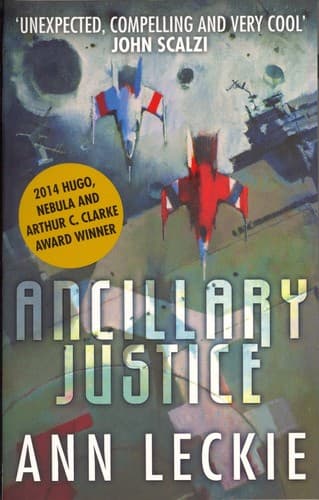
Book details and cover from Google Books.
Ready to read Ancillary Justice?
Get your copy on Amazon, or listen to it on Audible. We earn a commission if you buy through these links.